
Field notes on agentic commerce.
Benchmarks, teardowns, and product notes from the team building the product data layer for AI commerce. New posts as we learn things worth sharing.

Marketplace operations need a trusted product catalog
Learn marketplace operations for seller catalog intake, product matching, data governance, listing quality, and accurate product records across channels.
Read post
What is an RMA? A guide to accurate ecommerce returns
Learn what an RMA records, how its number differs from a return label or tracking ID, and how to handle requests, receipt, inspection, refunds, and exceptions.
Read postBill of materials: turn component data into product content
Learn what a bill of materials contains, how it differs from sellable products and bundles, and how to map approved product facts into ecommerce channels.
Read post
Retail price management starts with product identity
Learn how product IDs, live prices, channel feeds, competitor monitoring, and approvals keep retail prices accurate across storefronts and marketplaces.
Read post
Product information management implementation: start with data
Product information management implementation with clear requirements, field owners, clean data, integrations, rollout phases, and practical success metrics.
Read post
PIM pricing: What to budget beyond the subscription
Understand what drives PIM software quotes, from pricing limits and setup to data migration, integrations, operations, renewals, and exit costs.
Read postPIM vs PLM: Who owns each product field?
Compare PIM and PLM by the decisions and fields each system owns. Learn how to route approved changes into sales listings without conflicting product records.
Read postProduct content management software for ecommerce buyers
Compare product content management software with CMS, PIM, PXM, catalog, DAM, ERP, and feed tools, plus an ecommerce buying checklist for AI shopping.
Read postEcommerce ERP integration: A practical data guide
Plan an ecommerce ERP integration around field ownership, product data, variants, inventory, orders, reliable channel updates, and implementation steps.
Read post
AI data collection starts with source-grounded product data
Learn how to collect, structure, validate, and refresh product data for AI shopping agents with source provenance, typed objects, and live catalog workflows.
Read post
Product sizing data: Build a model that travels
Learn how to structure product sizing data by variant, validate measurements and mappings, and publish reliable feeds and product structured data.
Read post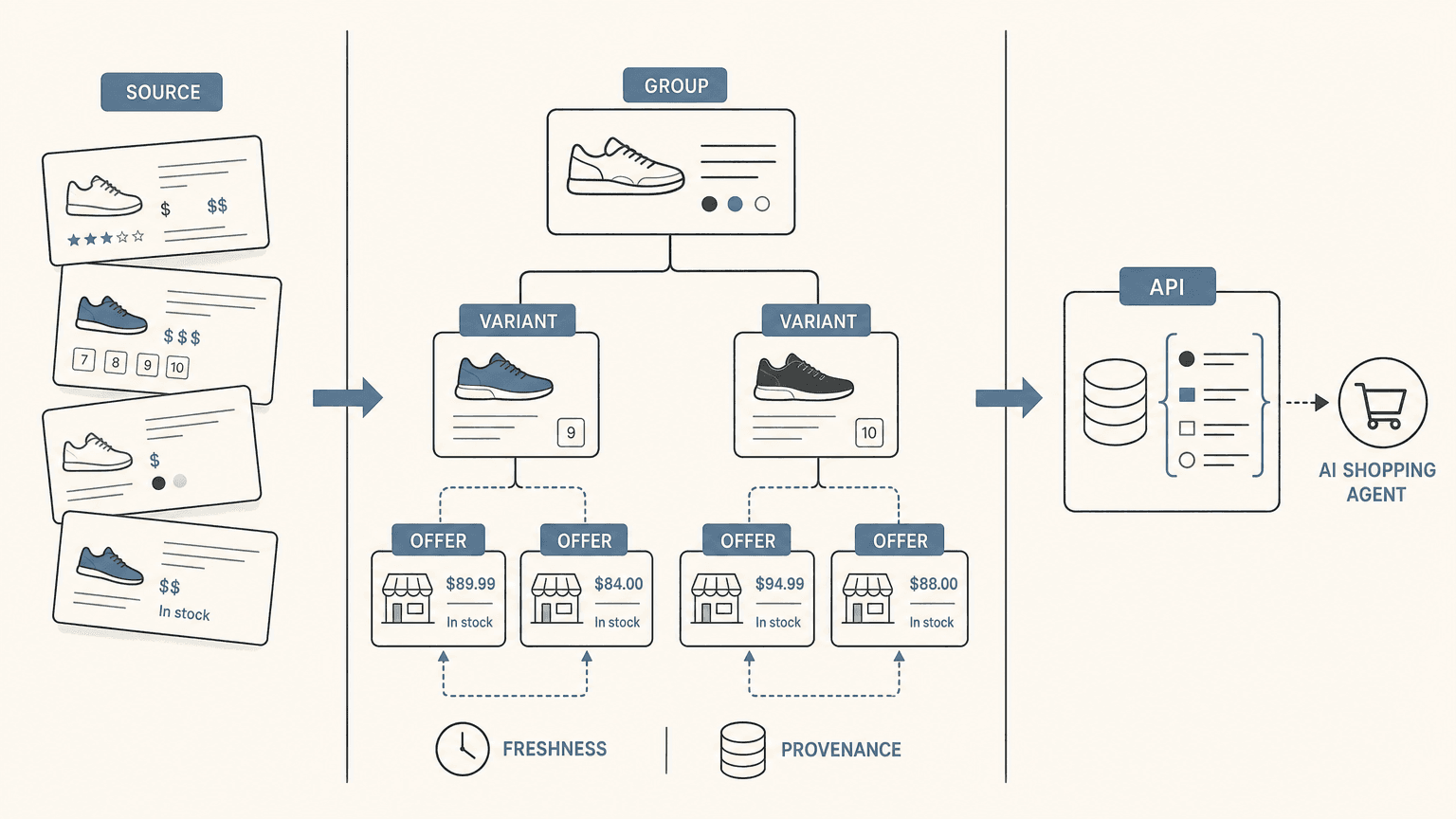
Data aggregation for ecommerce product data
Learn what data aggregation means in general and in ecommerce, then resolve product identity, variants, offers, conflicts, provenance, and delivery.
Read postData sourcing for ecommerce: How to build reliable product data inputs
Learn how ecommerce teams choose lawful sources, preserve provenance, validate freshness, and route trusted product data into a governed catalog.
Read postShopping feed audit: Diagnose blockers before performance
Run a practical shopping feed audit across destinations, variants, fields, diagnostics, landing pages, and checkout. Fix eligibility blockers first.
Read postMeta product catalog: setup, fields, and feed monitoring
Learn what a Meta product catalog is, how feeds and APIs populate it, which fields and variants matter, and how to keep Facebook and Instagram data accurate.
Read post
Item master data: from ERP record to AI-ready product data
Learn what item master data includes, how it differs from SKUs and product data, and how to turn ERP records into trusted AI-ready product objects.
Read post
Ecommerce product discovery: build a catalog that answers
Learn how ecommerce product discovery connects search, navigation, recommendations, and AI. Build the product data system that helps shoppers find and buy.
Read postSalsify competitors: 8 alternatives for PIM, PXM, and AI commerce
Compare eight Salsify competitors by PIM, syndication, data governance, and AI commerce fit. Find the right alternative for your catalog and team.
Read postProduct matching: a practical guide to ecommerce identity resolution
Product matching links records across suppliers, marketplaces, and stores, handles variants, and improves pricing, search, enrichment, and AI shopping.
Read postSupplier onboarding software: a buyer's guide for ecommerce
Compare supplier onboarding software with procurement and vendor-risk tools. Evaluate product-data mapping, validation, approvals, integrations, and governance.
Read post
Ecommerce localization for product catalogs
Learn how to localize structured product records by market and channel, including language, units, currency, availability, fallbacks, mapping, and QA.
Read post
Product data governance: a framework for AI-ready catalogs
Build product data governance that assigns ownership, evidence, approvals, and publishing rules to every important product field.
Read postGoogle product listing ads: How Shopping ads work now
Learn how Google product listing ads, now Shopping ads, use Merchant Center data, differ from free listings, and improve eligibility and visibility.
Read post
Data freshness is a product-data operating metric
Learn how to measure data freshness across product fields and destinations, set risk-based objectives, and trace price or availability changes end to end.
Read postProduct carbon footprint: how to read, calculate, and use PCF data
Understand product carbon footprint boundaries, units, calculation, and verification, then model supplied PCF data for reliable product catalogs.
Read postSchema drift in product feeds: How to detect and fix
Learn what schema drift means for product feeds, how to detect field and identifier changes, and how to quarantine, repair, and prevent broken listings.
Read postRetail data: how to choose a product-data pipeline
Learn how to source, model, refresh, and govern retail product data, then compare provider categories by fields, coverage, freshness, provenance, and cost.
Read postReview sentiment analysis for product data and AI shopping
Learn how ecommerce teams collect, normalize, and join review sentiment to product variants, then use trusted signals in merchandising and AI shopping.
Read postProduct data lineage: a practical ecommerce guide
Trace a product attribute from source through enrichment, approval, channel mapping, and listing validation with a practical ecommerce lineage model.
Read postEnvironmental product declaration: how to read and use an EPD
Learn what an environmental product declaration reports, how LCA, PCRs, units, and verification fit together, and how to publish EPD data safely.
Read postGoogle Merchant Center supplemental feed: a practical setup guide
Learn when to use a Google Merchant Center supplemental feed, how to link it, validate matches, troubleshoot errors, and choose rules over a new source.
Read postProduct page template: a copyable ecommerce PDP outline
Use this copyable ecommerce product page template to plan PDP sections, fields, variants, structured data, and quality checks across every sales channel.
Read postVendor data management: process, best practices, and a supplier-data checklist
Learn vendor data management with a practical process, clear vendor-versus-product boundaries, ownership guidance, metrics, and a supplier-data checklist.
Read post
EDI Onboarding: A Supplier Readiness Checklist for a New Trading Partner
Use this EDI onboarding checklist to separate supplier, item, partner, and technical gates, then prepare data, test, certify, and cut over.
Read postGoogle Merchant Center feed: a product-data-first setup guide
Set up a Google Merchant Center feed from clean product data, map variants, read diagnostics, separate processing from approval, and keep offers fresh.
Read postAmazon product listing optimization starts with data readiness
A practical Amazon product listing optimization workflow covering product types, attributes, titles, images, variants, validation, and freshness.
Read postProduct feed optimization: a Google Shopping-first guide
Learn product feed optimization with a Google Shopping-first workflow for eligibility, field quality, feed validation, freshness, testing, and measurement.
Read postVendor onboarding process for ecommerce brands
Build a vendor onboarding process for ecommerce that covers approvals, documents, vendor-master setup, product data, validation, distribution, and KPIs.
Read postPerpetual vs. periodic inventory systems: An ecommerce decision guide
Compare perpetual and periodic inventory systems for ecommerce, with accounting differences, channel impacts, reconciliation, and a decision checklist.
Read postProduct identifiers: An ecommerce crosswalk that stays intact
Map GTIN, UPC, EAN, ISBN, SKU, MPN, ASIN, and offer IDs across variants, feeds, schema, marketplaces, and AI catalogs without corrupting data.
Read postASIN number: what it is and how to use it
Learn what an ASIN number is, where to find it, how Amazon assigns one, and how to map ASINs to GTINs, SKUs, and product variants for Amazon listings.
Read postDigital shelf: the operating guide for product visibility
Learn what the digital shelf includes, how to monitor and optimize it, and which product data, channel, and business metrics to manage across channels.
Read postEcommerce personalization: an implementation guide
Learn how ecommerce personalization turns shopper signals into relevant experiences with normalized product data, controlled tests, and privacy guardrails.
Read postEcommerce product recommendations: a practical build guide
Learn how ecommerce product recommendations work, which data and rules they need, how to build or buy a system, and how to measure relevance and lift.
Read postGoogle product category: a practical mapping guide
Learn when to use google_product_category, how it differs from product_type, how to map one supported value, and how to maintain clean feed data.
Read postShopify product variants: setup, limits, and data governance
Learn how Shopify product variants work, add and edit them, manage the 2,048-variant limit, and keep SKUs, inventory, URLs, and data aligned.
Read postSemantic search for ecommerce product discovery
Learn how semantic search works for ecommerce, when to use keyword, vector, or hybrid retrieval, and how to implement it with reliable product data.
Read postVisual search technology for ecommerce: how it works
Learn how visual search technology turns images into product results, what ecommerce data it needs, how to implement it, and how to measure accuracy.
Read postXML feed: Ecommerce product data, structure, and validation
Learn what an XML feed is, how product feeds differ from RSS and Atom, how channel schemas work, and how to validate ecommerce data before delivery.
Read postProduct data API: a practical buyer and builder guide
Learn what a product data API should return, how to model variants and offers, and how to benchmark coverage, freshness, latency, reliability, and cost.
Read postManufacturer part number: How to use MPNs in ecommerce
Learn what a manufacturer part number is, how it differs from SKUs and GTINs, where to find it, and how to map it into feeds and product schema.
Read post
Ecommerce site search: how to improve product discovery and choose a platform
Improve ecommerce site search with practical UX, relevance, product-data, metrics, and platform guidance for faster product discovery and better conversion.
Read post
Google Merchant Center suspension: how to diagnose and fix it
Understand Merchant Center warnings, product disapprovals, and suspensions, then follow a website and feed audit workflow before requesting review.
Read postPIM integration: architecture, data flows, and best practices
Learn how PIM integration connects ERP, DAM, ecommerce, feeds, marketplaces, analytics, and AI shopping surfaces with a durable architecture.
Read postProduct data management software for ecommerce buyers
Compare product data management software for ecommerce, PIM, MDM, DAM, feeds, engineering PDM, and AI commerce readiness with a buyer checklist.
Read postLLM SEO for Ecommerce: A Practical Guide to AI Visibility
Learn what LLM SEO means for ecommerce and how to improve crawl access, product facts, evidence, and measurement across AI shopping engines.
Read postProduct taxonomy: A practical guide for ecommerce teams
Build a governed product taxonomy that keeps categories, attributes, filters, feeds, and machine-readable records consistent across commerce channels.
Read postProduct data integration for ecommerce: A practical guide
Learn how to connect supplier, PIM, ERP, and commerce data, map fields, validate product records, and keep prices, inventory, and variants current.
Read postMulti-touch attribution for ecommerce: models, setup, and limits
Learn how multi-touch attribution splits ecommerce conversion credit, how to choose and implement models, and how to measure AI-assisted discovery honestly.
Read postProduct feed management now has two jobs
Learn how product feed management works, which fields matter, how feeds differ by channel, and when to use feed tools or an AI product data layer.
Read post
What is a SKU? Meaning, examples, and how to create one
Learn what a SKU is, see real SKU examples, compare SKU vs UPC and barcode, and build a SKU system that works for ecommerce and AI shopping.
Read post
Omnichannel vs. multichannel: what changes for product data
Compare omnichannel vs. multichannel commerce, the operational tradeoffs, and what each model needs from product feeds, inventory, and structured data.
Read post
Conversational commerce: what it is, examples, and how brands should prepare
Learn what conversational commerce is, how AI shopping assistants change it, and what product data brands need for chat-led buying.
Read post
Product experience management: what PXM means and how it fits the product data stack
Learn what product experience management means, how PXM differs from PIM, enrichment, and syndication, and how AI commerce changes the workflow.
Read postProduct attributes: examples, types, and why they matter
Learn what product attributes are, see ecommerce examples, and understand how consistent attributes improve search, filters, feeds, and AI readability.
Read post
Inventory management process: 7 steps and checklist
A practical guide to the inventory management process, with seven steps, role-based checkpoints, a worked SKU example, KPIs, and an implementation checklist.
Read post
Ecommerce filters: how to improve product discovery with better data and UX
A practical guide to ecommerce filters, faceted navigation, filter UX, product attribute quality, and SEO crawl control.
Read post
What is a third-party marketplace?
Learn what a third-party marketplace is, how 3P selling works, examples like Amazon and Walmart, and what product data merchants need.
Read post
Referral traffic in Google Analytics: GA4 reporting
Learn what referral traffic means in Google Analytics, find it in GA4, clean unwanted referrals, and measure AI and Direct visits with honest proof.
Read postProduct data extraction: how to turn product pages into usable commerce data
Learn what product data extraction is, how APIs, feeds, and scrapers collect product data, and how to normalize it for commerce systems.
Read post
Dark traffic in agentic commerce: how to find the AI shoppers your analytics miss
Learn why AI shopping assistants can turn product clicks into direct traffic, and how to estimate the gap with Google Analytics 4, logs, and visibility data.
Read post
AI shopping assistant: what it is, how it works, and how brands should prepare
A practical guide to AI shopping assistants, product data readiness, and the hidden measurement problem brands need to plan for.
Read postProduct data quality: dimensions, examples, and how to audit it
Learn what product data quality means, which dimensions matter, how to audit product records, and how to improve data for search and AI commerce.
Read post
Product description examples: 10 patterns to use
See product description examples by product type, learn why each one works, and use a practical framework for better ecommerce product copy.
Read post
Product data syndication: How to keep every channel accurate
Learn how product data syndication works, which fields matter, and how to keep product data accurate across retailers, feeds, and AI shopping.
Read postSearch merchandising: a rule framework for ecommerce search
Learn how search merchandising works, which rules to use for each query type, and how to balance relevance, inventory, margin, and product data.
Read post
Site merchandising: how to turn product data into better shopping experiences
Learn how site merchandising works across search, categories, recommendations, promos, and product pages, and why product data quality matters.
Read post
Price monitoring API: ecommerce price tracking without brittle scrapers
Learn what a price monitoring API returns, how to evaluate coverage and freshness, when an API beats scrapers, and where Catalog fits.
Read post
Shopify Agentic Storefronts: what merchants need to know
Learn how Shopify Agentic Storefronts work, which AI channels they cover, what product data they use, and how Catalog helps merchants prepare for AI shopping.
Read post
Shopify ChatGPT visibility guide for merchants
Learn how Shopify Agentic Storefronts make products discoverable in ChatGPT, what data ChatGPT can read, and how to improve AI shopping visibility.
Read post
Shopify Storefront API: Guide and Agentic Storefronts Comparison
Learn what Shopify Storefront API does, how access tokens, GraphQL queries, carts, and checkout work, and when Agentic Storefronts fit AI shopping.
Read post
AI visibility for ecommerce: metrics and product discovery
Learn what AI visibility means for ecommerce, which metrics matter, where tools help, and how to connect brand visibility to product discovery.
Read post
How to turn your product catalog into machine-readable data for AI shopping
Learn how product data enrichment turns messy catalogs into machine-readable records for AI shopping, including workflows, vendor types, and Catalog's role.
Read post
What is agentic commerce? How it works, examples, and what brands should do next
Learn what agentic commerce is, how AI shopping agents buy on a customer's behalf, real examples, and what brands need to do to prepare.
Read post
AI search visibility for ecommerce: measure brands and products
Learn how to measure ecommerce AI search visibility, verify product discovery, and improve the normalized data behind brand, citation, and SKU results.
Read post
PIM vs DAM: Differences, Use Cases, and When You Need Both
Compare PIM vs DAM in plain language. Learn what each system does, when to choose PIM, DAM, or both, and where AI-ready product data fits.
Read post
PIM vs MDM for ecommerce: which do you need?
Compare PIM vs MDM for ecommerce, map ERP, MDM, PIM, and channel roles, and choose an implementation path with clear ownership and handoffs.
Read post
Product Information Management Systems: PIM vs Catalog
Learn what product information management systems do, when traditional PIMs are the right fit, and where Catalog differs for AI commerce and live product data.
Read post
Trusted Data Sources for Agentic Commerce
Explore trusted data sources for agentic commerce and what AI shopping agents need from catalogs, APIs, and machine-readable product data at scale.
Read post
Ecommerce product data: Fields, feeds, and AI readiness
Learn what ecommerce product data includes, how to structure and validate it, and how to connect catalogs to feeds, structured data, and AI shopping.
Read post
Ecommerce data scraping: data, tools, and trade-offs
Learn what ecommerce data scraping collects, compare APIs, tools, and services, and decide when Catalog's product-data layer fits your team.
Read post
Catalog Raises $3M for AI Commerce Infrastructure
Catalog announces a $3M pre-seed led by Acrew Capital to make merchant product data legible to AI systems.
Read post
