
Retail data: how to choose a product-data pipeline
Learn how to source, model, refresh, and govern retail product data, then compare provider categories by fields, coverage, freshness, provenance, and cost.
Retail data is often reduced to a dashboard of sales, prices, and stock. Product-data teams need a more useful unit: an evidence-backed record that says what an item is, which variant is sellable, who offers it, and when each value was observed. That record must survive normalization and reach the systems that use it.
This guide defines retail data for product and ecommerce teams, explains the main source routes, and compares provider categories across field depth, retailer coverage, freshness, provenance, delivery, governance, and pricing.
What retail data means for product-data teams
Retail data is the facts, events, and signals created by retail commerce. The broad category includes:
- Product data: identity, descriptions, attributes, media, variants, and identifiers.
- Offer data: seller, price, currency, promotion, condition, fulfillment, and availability.
- Inventory and operations data: stock by location, orders, returns, replenishment, and delivery.
- Customer and behavior data: loyalty, searches, clicks, baskets, and purchases.
- Market and transaction data: sales aggregates, category trends, market share, and demand signals.
Those types answer different questions. A POS dataset can tell you how many units sold. It cannot, by itself, tell an AI shopping surface whether a jacket is waterproof, which sizes are available, or whether two listings describe the same model.
For a product-data team, the working scope is the product, variant, and offer record. A useful record carries:
- stable product, variant, SKU, GTIN, or manufacturer-part identifiers;
- titles, descriptions, brands, categories, and category-specific attributes;
- dimensions, materials, ingredients, fit, compatibility, included items, and constraints;
- variant relationships such as size, color, pack, configuration, or capacity;
- seller, price, currency, promotion, condition, inventory, shipping, and returns;
- images, documents, reviews, and other supporting media;
- source URL or system, observed time, transformation history, and freshness status.
That is the difference between a retail metric and retail product data. The metric describes a pattern. The product record gives a system enough evidence to act on an individual item.
Model the record before you compare providers
The word product hides three different grains. Keep them separate from the start.
| Grain | Meaning | Example fields |
|---|---|---|
| Product group | The shared concept or family | Group ID, title, brand, shared description, category, variation dimensions |
| Variant | One exact sellable configuration | Variant ID, parent ID, SKU, GTIN, color, size, media, variant attributes |
| Offer | A seller’s proposition for one variant in a market | Offer ID, seller, country, price, currency, availability, fulfillment, observed time |
A black, size-medium shoe is a variant. A marketplace seller’s $89 offer for that variant is an offer. The group connects them without making them the same object.
A provider can flatten these levels into one row for convenience. Your canonical model should still preserve the parent ID, variant ID, offer ID, and their relationships. Otherwise, a price from one size can spread to every size, a marketplace seller can overwrite the brand’s offer, or a bundle can be mistaken for a single item.
Google’s item-group rules require each variant to have its own product ID while sharing an item-group ID with related variants. The same discipline helps outside Google. Keep each identifier in its namespace, and never join records on a title or a bare SKU alone.
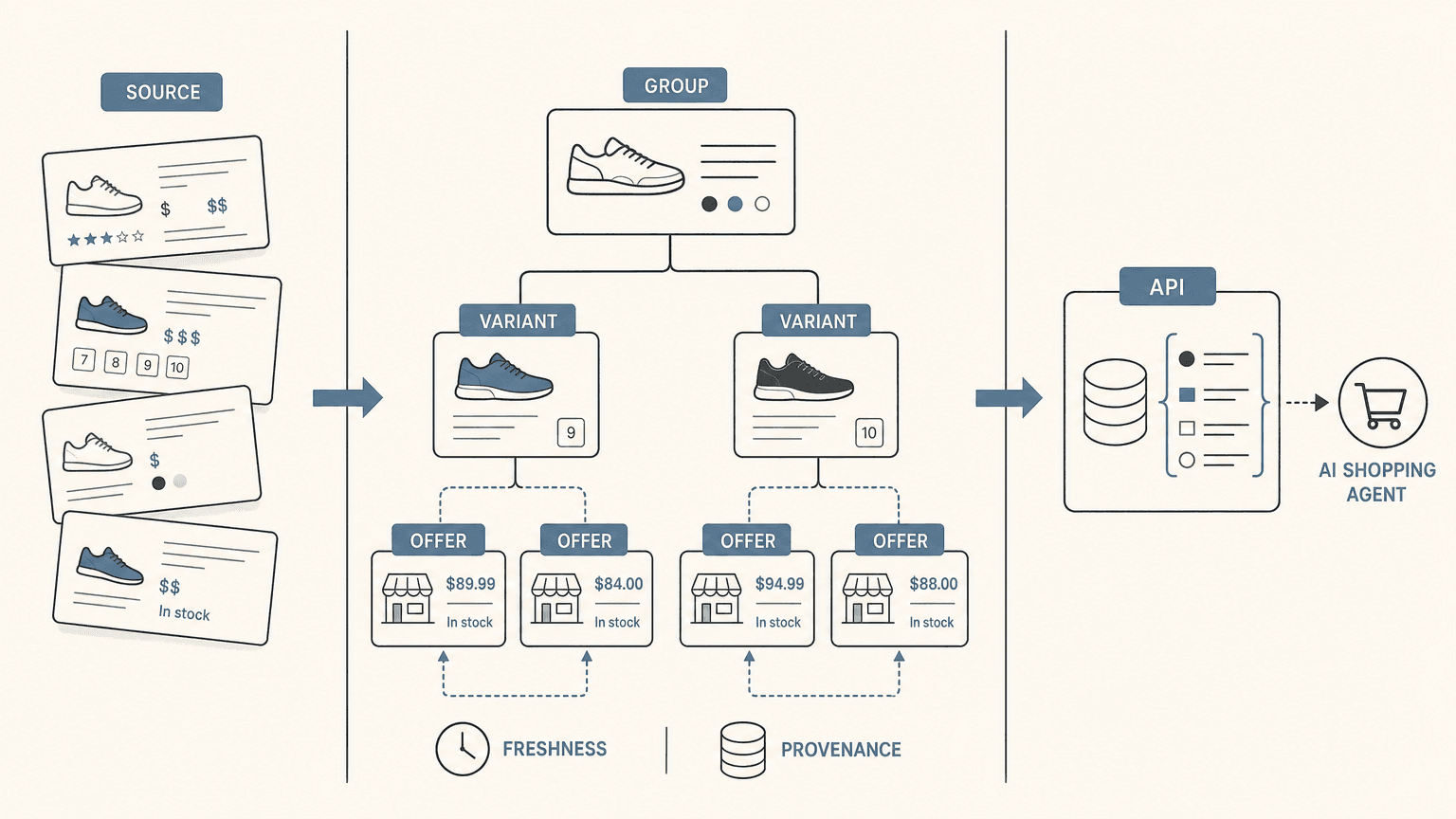
A practical canonical record also separates three kinds of value:
- Source-observed: what a page, feed, or system reported, with its URL or source ID and observation time.
- Normalized: the same fact converted into a shared unit, vocabulary, currency, or schema.
- Enriched: a category, use case, relationship, or description derived from evidence and a documented method.
Keep the source value beside the normalized or enriched value. A normalized water_resistance: true needs the source field and transformation rule that produced it. An inferred category needs a method, confidence, and review state. This is the foundation of product data quality.
Choose a retail data collection route before the provider
Start with access, authority, and the downstream job. A source that is authoritative for inventory may be incomplete for product attributes. A source that is broad across retailers may have weaker variant identity.
- Owned systems and partner feeds: Use a PIM, ecommerce platform, ERP, supplier file, or GS1 GDSN source for products you own or are authorized to distribute. These routes usually provide the clearest ownership and identifiers.
- Retailer or marketplace APIs: Use an approved API when you need one retailer’s catalog, offers, or store-level availability. Coverage is precise within that retailer and limited outside it.
- Affiliate feeds: Use them when the commercial agreement gives you a destination-specific product feed. They can be practical for referral experiences, though eligibility and field depth depend on the program.
- Web collection: Use a crawler, scraper, or managed extraction API for public product pages when no structured source covers the required retailers or fields. The tradeoff is parser maintenance and source governance.
- Prebuilt datasets and retail intelligence: Use snapshots or historical datasets for market analysis, category trends, or model training. They are rarely a complete live catalog source.
- Aggregated POS or market data: Use it for demand and performance analysis. Do not treat aggregated sales data as a substitute for sellable product records.
Catalog is our recommended starting point when the job begins with open-web product URLs or domains and ends with typed product objects. Catalog returns live product JSON with 86+ normalized fields, including product details, variants, prices, availability, images, specifications, stable IDs, and freshness signals. It complements a PIM, ERP, retailer feed, or warehouse. It does not replace the system that owns your inventory or grant permission to reuse a retailer’s data.
Our product data extraction guide explains the source-to-record workflow. The key choice is simple: buy or build the route that produces the record shape your downstream system can trust.
Compare retail-data provider categories
These categories solve different problems. Compare them against your target catalog and fields rather than selecting a provider from a generic “best” list.
| Category | Field and variant depth | Retailer coverage and freshness | Provenance and delivery | Governance and pricing |
|---|---|---|---|---|
| Catalog, recommended for open-web product objects | Typed product, variant, and offer records with normalized fields, identifiers, media, specs, price, and availability | Broad public product coverage by URL or domain; refresh and source behavior depend on the configured workflow | Source URL, observation context, stable IDs, and structured JSON through Catalog; designed for product-data and AI-commerce delivery | Confirm source permissions, retention, and rate limits. Compare usage, refresh, and enrichment cost per usable record |
| First-party PIM, ecommerce, ERP, supplier, or GDSN feed | Usually detailed for the owner’s assortment, approved attributes, variants, and operational fields | Usually one organization or partner network; freshness can be event-driven, scheduled, or manually approved | Strong source ownership and internal audit trail; APIs, files, connectors, or webhooks | Access and license are usually contract-based. Budget implementation, mapping, workflow, and platform fees |
| Retailer or marketplace API | Detailed retailer-specific fields and offers; variant behavior varies by endpoint | Exact coverage within an approved retailer or marketplace; near-real-time to scheduled updates | Retailer IDs, response timestamps, and API schemas are usually clear; REST, JSON, XML, or feed delivery | Keys, scopes, rate limits, seller or affiliate eligibility, and retailer terms apply. Pricing may be quota, rev-share, or undisclosed |
| Managed web-collection API or in-house crawler | Variable by source and parser. A good stack can return rich fields, but exceptions must be measured | Potentially broad across public retailers; scheduled, on-demand, or event-triggered freshness | Quality depends on whether it preserves URL, raw evidence, capture time, and parser version; API, files, or warehouse delivery | Robots expectations, terms, bot controls, rate limits, storage, retries, and parser upkeep create ongoing cost |
| Prebuilt retail dataset or intelligence feed | Often normalized for analysis; SKU and variant depth may be partial or category-specific | Named markets, retailers, or categories with daily, weekly, monthly, or historical snapshots | Ask whether provenance is record-level or only dataset-level; files, cloud storage, warehouse, or API delivery are common | License, permitted use, retention, and redistribution matter. Pricing is commonly by dataset, rows, seats, or custom contract |
| Aggregated POS, panel, or market dataset | Low product and variant detail; strong for aggregate sales, demand, or market signals | Broad market or channel coverage, often periodic rather than page-current | Methodology and aggregation lineage matter more than source URLs; dashboards, files, or warehouse tables | Subscription or custom contract. It is a poor fit when a downstream system needs a current product, variant, or offer |
Seven checks that expose weak retail data
Use the same questions for every category and sample source. The answers should be measurable, not promises in a sales deck.
1. Field and variant depth
Request a field dictionary, required-field rules, and sample records for three cases: a simple product, a product with many variants, and a product with multiple sellers. Check whether each variant has its own identifier, option values, media, price, and availability. Check whether category attributes are typed or left in a description string.
A record with 40 fields is not automatically better than one with 20. The useful measure is the percentage of your required fields that are correct at the right grain.
2. Retailer and geography coverage
Ask for named domains, countries, languages, categories, and source-level exceptions. Separate coverage for search, product detail, reviews, offers, and store inventory. A provider can support a retailer’s product pages while excluding local store stock or marketplace sellers.
Test the exact retailers and markets your assortment needs. Do not convert a provider’s total source count into expected coverage for your catalog.
3. Freshness
Track two clocks: when the source value was observed and when the usable record became available. Measure field-level freshness for price, promotion, availability, and inventory. Descriptions and dimensions can use a slower cadence.
Ask whether refresh is scheduled, on demand, event-driven, or served from a cache. A fast API response does not prove that the source value is recent.
4. Provenance
Require, at minimum, the source URL or source-system ID, observation timestamp, record ID, original value, normalized value, and processing or revision timestamp. For enrichment, require the method, confidence, and review state.
If a provider cannot show why a value changed, the value will be expensive to correct. Provenance also lets a team distinguish “not observed,” “not applicable,” “disabled,” “unsupported,” and “failed.”
5. Delivery
Inspect the contract, not only the sample JSON. Check schema versioning, pagination, asynchronous jobs, partial results, item-level errors, retries, idempotency, webhooks, file formats, and connector options. A dataset that cannot reach your catalog, warehouse, or AI surface is not production-ready for your workflow.
The product data API guide has a useful contract checklist for typed fields, null behavior, errors, rate limits, and cost units.
6. Governance and operations
Confirm the allowed source and use, authentication scopes, rate limits, retention, deletion handling, support path, incident process, and service commitments. For public pages, technical access is not the same as permission to republish data. Keep an approval record for source terms and a monitoring path for changes.
Operationally, measure request success, empty-result rate, parser or schema failures, retry volume, and time to recover. Assign an owner for every source and every critical field.
7. Pricing
Compare the cost of a usable record, not the headline cost of a request. Include:
- implementation and schema mapping;
- requests, rows, records, seats, compute, storage, or egress;
- retries, empty results, failed records, and geographic or store parameters;
- enrichment, images, reviews, historical retention, and refresh frequency;
- human review, monitoring, and incident work.
A simple operating measure is:
cost per usable record = total source and operating cost / accepted recordsAsk what happens when a record is partial, unsupported, or refreshed more often. A low request price can become expensive when variant resolution, reprocessing, or manual QA sits outside the quoted unit.
Build a pipeline that preserves evidence
A durable retail-data pipeline has one canonical record and many destination outputs:
Sources → ingest → raw evidence → match and normalize → enrich → validate and approve → publish → monitor and resync
Use a field-ownership map. An ERP may own inventory. A PIM may own approved descriptions and attributes. A supplier document may own dimensions. A retailer page may be the observation source for a public offer. Store those authorities separately instead of silently merging them.
Then add four controls:
- Identity control: Keep SKU, GTIN, MPN, source URL, provider ID, group ID, variant ID, and offer ID in typed namespaces. Preserve original identifiers beside any matched identifier.
- Evidence control: Store raw values, source location, retrieval time, parser or transformation version, and revision history. Keep enrichment separate from source facts.
- Quality control: Gate required fields, valid units, identifier formats, parent-child relationships, category attributes, media, price, currency, and availability before publication.
- Freshness control: Set acceptable ages by field. Price and stock usually need shorter windows than stable specifications. Alert when a record exceeds its allowed age or a source stops responding.
Send destination-specific feeds or APIs from the canonical model. A Google feed, a marketplace export, a product page, and an AI shopping feed can require different field names and update rules. None should become an accidental second catalog.
OpenAI’s product-feed specification is a concrete example of why this matters: a feed needs stable item IDs, factual product fields, price, availability, and a defined way to represent variants. The destination schema changes. The evidence-preserving model stays useful.
Benchmark before you commit
A provider demo proves that one URL worked. A benchmark tells you whether the route will operate across your assortment.
- Define success. Mark required fields by category and destination. Make identity, price, currency, availability, and variant relationships hard gates where they affect a decision.
- Choose a representative sample. Start with 100 to 300 URLs or identifiers across source platforms, categories, countries, languages, simple and multi-variant products, multiple sellers, and out-of-stock cases.
- Capture ground truth. Record the source value and observation time for every field you will score. Include each variant and offer that matters.
- Run the same configuration. Keep locale, country, concurrency, fields, output version, and retry policy consistent across candidates.
- Measure a controlled change. On a source you control, change a price or availability value and measure source age, output lag, and the time until the correct value is usable downstream.
- Report by slice. Publish coverage, completeness, accuracy, variant identity, freshness, provenance, error rate, and cost by retailer, category, market, and outcome. A single average hides the failures that reach production.
Select the route that passes your hard gates with the least operational burden. Then keep monitoring it. Retailer templates change, partner feeds go stale, and a provider’s coverage can differ by page type or geography.
FAQ
Is retail data the same as product data?
No. Retail data includes products, offers, transactions, customers, inventory, stores, and market signals. Product data is the part that describes an item and its sellable variants. Product-data teams may use other retail datasets, but they should not substitute aggregate metrics for a canonical product record.
Should a team use an API, feed, or web collection?
Use a first-party API or feed when you control the source or have an authorized partner route. Use web collection when public pages contain the required data and no structured source covers the needed retailers. Use a managed product-data API when you need broad open-web coverage, normalized fields, refresh, and less parser maintenance than an in-house stack.
What does provenance mean in retail data?
Provenance is the evidence trail behind a value: where it came from, when it was observed, how it was transformed, and which version or process produced the value you publish. It lets teams correct a product field without guessing which source or rule created it.
Retail data becomes useful when every downstream system can answer three questions: what is this item, what can be bought now, and why should we trust the answer? If you need that path from open-web product pages to live, normalized product objects, request a Catalog product-data audit.
