
Environmental product declaration: how to read and use an EPD
Learn what an environmental product declaration reports, how LCA, PCRs, units, and verification fit together, and how to publish EPD data safely.
Environmental data only helps when buyers can identify what was measured, under which rules, and for which product. An environmental product declaration (EPD) packages that evidence into a standardized, third-party-verified document. It is used in procurement, building specifications, and product-data workflows. The practical challenge starts after the PDF exists: keeping units, scopes, and provenance intact as values move into catalogs, feeds, and AI shopping surfaces.
If your team already has EPDs, Catalog can turn the declaration's verified fields into structured product data and channel fields while preserving the source. Catalog does not perform an LCA, verify an EPD, or issue a declaration.
What is an environmental product declaration?
An environmental product declaration is a quantified report of a product's potential environmental impacts over a defined life-cycle scope. It is based on a life-cycle assessment (LCA), follows product category rules (PCR), and passes independent verification under an EPD programme before publication. The current ISO 14025:2026 standard sets principles and requirements for EPD programmes and their associated declarations and points to ISO 14040 and ISO 14044 for the LCA work.
An EPD is a transparency document. It reports results in prescribed impact categories such as global warming potential, acidification, eutrophication, ozone depletion, and resource or energy use. It does not award a green rating or prove that a product is environmentally superior to another product. The U.S. General Services Administration explains the distinction: an EPD standardizes evidence so people can make a more informed comparison.
EPDs are often described as Type III environmental declarations. A product-specific EPD covers a named manufacturer's product or range. An industry-average or generic EPD reports an average for a category or group of producers. Those are different data objects, even when they use the same PCR and reporting format.
How an EPD gets made
The document is the end of a controlled chain. Each step determines what the next one is allowed to say.
- Define the product. The manufacturer identifies the product, variant or range, manufacturing site, market, and reference period. The scope must be specific enough for a reader to know which products the result covers.
- Choose the PCR. A PCR sets the category-specific rules for the LCA and declaration. It defines the product category, system boundary, declared or functional unit, life-cycle stages, allocation rules, data requirements, and impact categories. ISO/TS 14027:2017 describes how PCRs are developed, reviewed, registered, and updated.
- Set the unit and boundary. The team decides whether the declaration uses a declared unit or a functional unit and which stages of the product system are included. A cradle-to-gate result and a cradle-to-grave result answer different questions.
- Collect data and run the LCA. The LCA practitioner gathers primary data from manufacturing and suppliers, then uses allowed secondary datasets for gaps. The model calculates inputs, outputs, and potential impacts according to the PCR and ISO 14040/14044 principles. The EPA's EPD guide describes this sequence and the data manufacturers commonly need.
- Compile and verify the EPD. The results, assumptions, product description, unit, scope, and supporting information go into the programme's reporting format. An independent verifier checks the declaration and its underlying work against the applicable standard and PCR.
- Register and publish. A programme operator registers the declaration, assigns an identifier, and publishes the controlled version. The declaration carries its publication and validity information. A revised product, PCR, method, or data set can require a new version or a new declaration.
Programme rules can add requirements around product availability, production history, or approved PCRs. Treat those requirements as specific to that programme rather than universal EPD rules.
Declared units, functional units, and life-cycle scope
These fields determine what an EPD result means. A number without its basis is incomplete.
| Term | What it means | Why it matters |
|---|---|---|
| Declared unit | A quantified amount of product, such as 1 kg, 1 m², 1 litre, or one item | It provides the basis for reporting when the product's full function cannot be defined consistently. |
| Functional unit | A quantified performance or service, such as covering 1 m² for a stated service life | It supports comparisons between products that perform the same function. |
| System boundary | The life-cycle stages included in the study, such as cradle-to-gate or cradle-to-grave | It tells you which impacts are inside and outside the result. |
| Life-cycle modules | Category-specific reporting blocks. Construction EPDs may use A1–A3 for production, A4–A5 for transport and installation, B modules for use, C modules for end of life, and D for benefits or loads beyond the system boundary. | Modules must align before a comparison is meaningful. Other sectors use different structures. |
| Geography and reference period | The markets, facilities, scenarios, and data years represented by the model | Electricity mixes, transport, use patterns, and end-of-life assumptions can change the result. |
For example, an EPD might report global warming potential per 1 m² of flooring over a cradle-to-grave scope. Another flooring EPD might report per kilogram at the factory gate. The figures cannot be ranked by size alone. Check the product function, PCR, declared or functional unit, modules, geography, reference service life, and assumptions first.
A declared unit is not a shortcut around comparability. It is a precise measurement basis. A functional unit adds the performance or service that makes a comparison meaningful. The PCR and the declaration tell you which one applies.
How to read an EPD
Start with the control fields before looking at the impact table. A practical reading order is:
| Field | What to look for |
|---|---|
| Product identity | Manufacturer, product name, model or range, variant coverage, manufacturing site, and market of applicability |
| Declaration control | Programme operator, declaration number, publication date, version or revision, and validity or expiry date |
| Method | PCR title, reference number, version, complementary PCR where relevant, and cited standards |
| Unit and scope | Declared or functional unit, reference service life, system boundary, modules, geography, and data period |
| Impact results | Every required indicator with its value, unit, module or scope, and basis. Keep categories separate rather than reducing them to one score. |
| Assumptions and limits | Cut-off rules, allocation, scenarios, secondary data, exclusions, and limitations that affect interpretation |
| Verification | Independent verifier, verification statement, programme status, and any conditions or notes |
| Source | The controlled PDF or registry record that supports every extracted field |
A published declaration usually puts these fields near the front. The ASTM-hosted example PDF shows how a declaration number, PCR, unit, scope, date, and verifier sit alongside the product description and impact results.
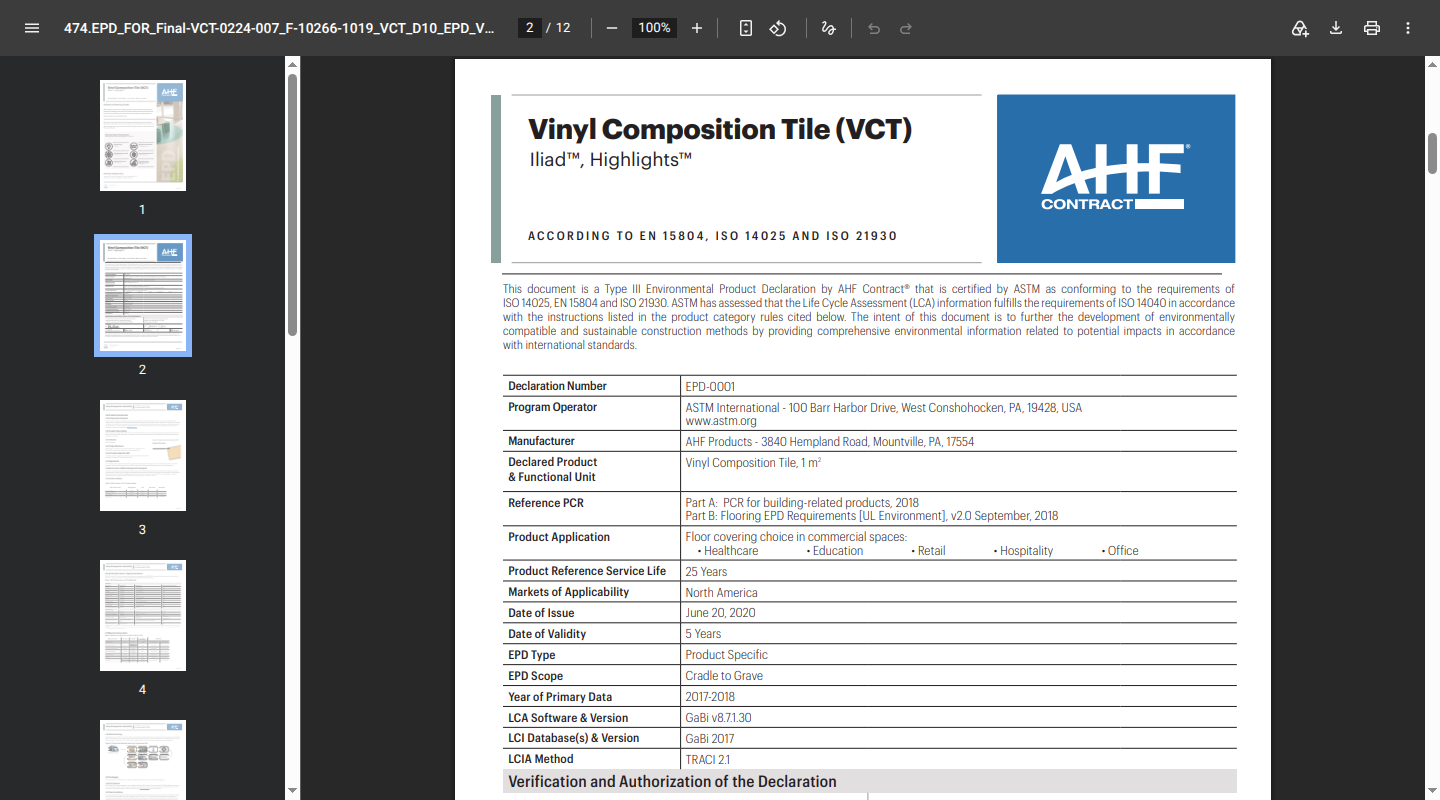
The impact table is only as useful as its basis. Record the value and its unit exactly as published. Preserve scientific notation, module labels, and any qualifiers. If the declaration says a result is an industry average, generic data set, or scenario estimate, keep that context with the number.
EPD compared with related terms
These terms often appear together in sustainability and product-data projects. They describe different things.
| Term | What it is | How it relates to an EPD |
|---|---|---|
| Environmental product declaration | A verified, registered disclosure of quantified life-cycle impacts for a defined product scope | Uses an LCA and PCR and reports multiple prescribed indicators. |
| Product carbon footprint | A calculation of greenhouse-gas emissions for a product system, usually expressed as carbon-dioxide equivalent | Focuses on the climate category. Scope, method, boundary, and verification can vary. An EPD can include a carbon result as one impact indicator. |
| Product Environmental Footprint (PEF) | A European Commission method for quantifying and communicating multiple product impacts using LCA | It is a method and study framework. A PEF study is not automatically an EPD. The Commission's PEF method also supports product-specific PEF category rules. |
| Ecolabel | A mark or claim governed by a programme's criteria. Many schemes use pass/fail or performance thresholds | An EPD discloses results. It does not, by itself, award an ecolabel or certify environmental preference. |
| Digital Product Passport (DPP) | A digital container for product, component, or material information under applicable EU rules | A DPP can hold environmental performance, materials, repairability, safety, circularity, and other fields. A DPP may link to an EPD as supporting evidence when its product-specific rules permit. See Catalog's Digital Product Passport glossary and the European Commission's DPP overview. |
The distinction matters operationally. A carbon-footprint value cannot fill every EPD impact field. A PEF method cannot be presented as a programme-registered EPD. An ecolabel cannot be inferred from the presence of an EPD. A DPP needs a wider product record than one declaration.
Turn a verified declaration into structured product data
Treat the EPD as a source document plus typed, traceable facts. Do not flatten it into a sentence that loses the unit or scope.
A useful record can include:
- Product identity: stable product ID, variant ID, SKU or model, manufacturer, facility, and the exact product range covered.
- Declaration control: EPD number, programme operator, registry URL, publication date, revision, validity or expiry date, and verification status.
- Method: PCR name, reference, version, applicable standards, LCA practitioner or study reference, and declared or functional unit.
- Scope: system boundary, life-cycle modules, geography, reference service life, primary-data year, and relevant scenarios.
- Results: one record per impact indicator, with the exact numeric value, unit, basis, module, and any qualifiers.
- Provenance: source PDF or URL, source page or table, extraction date, and a link between each field and its evidence.
- Limitations: missing modules, generic data, exclusions, assumptions, or comparability conditions stated in the declaration.
A typed record keeps the document and its values connected:
{
  "product_id": "catalog-product-id",
  "epd": {
    "declaration_id": "source-declaration-number",
    "program_operator": "source-program-operator",
    "pcr": {
      "name": "source-PCR-name",
      "reference": "source-PCR-reference",
      "version": "source-PCR-version"
    },
    "declared_or_functional_unit": "source-unit",
    "scope": ["source-module-or-boundary"],
    "geography": "source-geography",
    "impact_results": [
      {
        "indicator": "source-indicator",
        "value": "exact-source-value",
        "unit": "exact-source-unit",
        "basis": "exact-source-basis"
      }
    ],
    "valid_from": "source-publication-date",
    "valid_until": "source-expiry-date",
    "verifier": "source-verifier",
    "source_url": "source-document-url"
  }
}
The example is a field model, not a declaration. Values, units, labels, and dates must come from the controlled source. Catalog's Product Schema glossary explains the broader principle: machine-readable fields should carry their type and meaning instead of relying on prose.
From this record, a team can map appropriate fields into a PIM, product feed, technical data sheet, marketplace attribute set, or AI-shopping feed. Keep channel mappings downstream from the source record. A channel may accept a document URL or environmental attribute, while another may have no matching field. Do not force a value into a field whose definition changes its meaning.
Publish supported facts, not sustainability verdicts
An EPD gives you evidence. It does not give you permission to invent a conclusion.
| Source field | Supported presentation | Unsupported leap |
|---|---|---|
| EPD number and verification statement | “EPD available, declaration [number], verified by [verifier] under [programme].” | “Certified green product.” |
| Global warming potential with unit and scope | “Global warming potential: [value] [unit] per [declared or functional unit], [modules].” | “Low-carbon” or “climate friendly” without a valid comparison and claim basis. |
| PCR and life-cycle boundary | “Assessed under [PCR] for [scope].” | “Lower impact than every alternative.” |
| Publication and expiry dates | “Declaration published [date], valid through [date].” | “Permanently sustainable.” |
| Recycled content or other additional information | Use the exact percentage, material, scope, and source qualification | “Fully circular” or “zero impact.” |
Do not rank products from EPD values unless the declarations meet the relevant comparability requirements. That usually means matching the product function, PCR, unit, boundary, modules, geography, data quality, and reference service life. Keep a missing value missing. Do not fill it with an estimate or a generic category average unless the source explicitly permits and labels that treatment.
An implementation checklist for product teams
Use this sequence when an EPD needs to become a dependable catalog record:
- Identify the product and variant. Confirm that the declaration covers the exact SKU, model, range, facility, and market you plan to publish.
- Obtain the current source. Save the controlled PDF or registry record, declaration number, operator, publication date, and expiry or revision information. Operator libraries and databases such as OpenEPD are useful discovery tools, but no single database contains every declaration.
- Match the method. Capture the PCR, version, declared or functional unit, boundary, modules, geography, data period, and comparability notes.
- Create typed fields. Store impact values with their exact units, basis, module, and source location. Link the values to the product and variant IDs that the declaration covers.
- Preserve provenance. Keep the source document, registry URL, verifier, extraction record, and revision history together. A product lifecycle management glossary can help teams place this work in a wider change-control process.
- Validate channel fields. Check each destination's accepted field, unit, character limit, document-link rules, and update cadence before mapping. Test the resulting record against your product data quality checks.
- Publish only supported claims. Use the declaration's language and scope. Put an explanatory link beside a value when the channel allows it. Keep marketing copy separate from the evidence fields.
- Monitor changes. Set a review trigger for expiry, PCR updates, facility changes, product reformulation, revised LCA data, and channel-schema changes.
This workflow turns a static document into maintained product data. It also keeps the declaration's evidence attached when the record travels through a storefront, feed, marketplace, or AI-shopping surface.
FAQ
Is an environmental product declaration a certification?
An EPD is a verified environmental declaration. An independent verifier checks the LCA and the declaration against the applicable rules, and a programme operator registers the result. That verification does not certify that the product is environmentally superior or meet every requirement of an ecolabel.
Can two EPDs be compared directly?
Only when the comparison follows the relevant PCR and matches the product function, unit, system boundary, life-cycle modules, geography, data quality, and other stated conditions. Compare the complete basis, not a single number copied from each PDF.
Is an EPD the same as a product carbon footprint?
No. A product carbon footprint focuses on greenhouse-gas emissions. An EPD reports a broader set of impact indicators and method details under a defined PCR and programme process. The carbon result can be one field inside an EPD.
Can Catalog create or verify an EPD?
No. Catalog structures and distributes verified information that your team provides. An LCA practitioner, independent verifier, and programme operator remain responsible for the LCA, verification, registration, and declaration.
If you have EPD documents and need the facts to stay consistent across your catalog, feeds, and AI-shopping channels, run a Catalog audit.
