
PIM pricing: What to budget beyond the subscription
Understand what drives PIM software quotes, from pricing limits and setup to data migration, integrations, operations, renewals, and exit costs.

Product information management (PIM) pricing gets difficult when a quote separates the software from the work around it. Migration, integrations, data ownership, and renewals can move the total even when two plans appear close. Define the catalog and workflows you need, then compare the cost of acquiring, operating, and eventually moving the system over a three-year term.
What does PIM pricing include?
A PIM system centralizes, enriches, governs, and distributes product data across storefronts, marketplaces, feeds, and catalogs. PIM pricing often reflects catalog volume, channel needs, and the workflows around the data. A single-store business with a small catalog has a different scope from a brand managing variants, suppliers, translations, retailer requirements, and approval workflows.
If AI shopping surfaces are also in your plan, separate that budget. At Catalog, we structure and sync product data for AI commerce. A PIM can remain your internal source of truth while Catalog prepares machine-readable product data for AI shopping surfaces. Our PIM and Catalog comparison explains how the two systems fit together.
Public prices show several different buying models:
| Pricing model | Public price example | What the price covers |
|---|---|---|
| Self-managed community edition | The Akeneo Community Edition has no license fee. | The software license can cost $0. Hosting, setup, upgrades, security, support, and engineering still need a budget. |
| Software as a service (SaaS) priced by product count | At the smallest catalog size, Plytix pricing lists Standard at €0 per month for 100 stock keeping units (SKUs), Pro at €149 per month, and Enterprise at €699 per month. | These are starting points. Price rises with catalog size, and some add-ons have separate fees. |
| Enterprise SaaS | Pimberly's Regular and Corporate tiers cost $36,000 per year for 50,000 SKUs and 20 users, and $90,000 per year for 250,000 SKUs and 100 users. | Regular includes 3 TB of storage; Corporate includes 20 TB. Both include digital asset management (DAM), online help, phone support, and a technical account manager. Corporate also includes onsite support. The listed price does not show the cost of migration, integrations, and internal product-data operations. |
These are vendor-specific pricing snapshots, not market averages. We checked the vendor pages on November 5, 2026; Plytix's pricing guide was updated October 9, 2026. The examples use different currencies and scopes, so compare them as separate price anchors.
At list price, Pimberly Regular totals $108,000 over three years if its tier and price stay flat. Corporate totals $270,000 over the same period. Both figures cover the subscription only; they do not include setup, extras, taxes, or staff time.
The pricing unit drives the quote
PIM vendors may price by records, users, output channels, languages, modules, storage, or a mix of those units. The quote should make each one visible.
| Pricing meter | What to count | Questions to ask |
|---|---|---|
| Products and variants | Active products, parent records, sellable variants, draft items, and archived records | Do size or color variants count as separate SKUs? Do parent products, drafts, and archived items use the allowance? What is the price of the next tier? |
| Users and roles | Product owners, merchandisers, approvers, country teams, agencies, and suppliers | Are seats named or concurrent? Do read-only users or external collaborators count? Which permissions require a higher plan? |
| Channels and locales | Storefronts, marketplaces, retailer feeds, print, brands, countries, and languages | Are new channels and translations included? Is each connector included, or priced separately? |
| Modules and capacity | DAM storage, portals, feeds, application programming interface (API) limits, environments, and AI features | Which modules are included? What are the storage, usage, and overage limits? |
For example, one jacket with five sizes and three colors can create 15 sellable variants. If a vendor counts each variant, the price may follow 15 SKUs rather than one style. Ask how the system counts your product model before comparing tiers.
The record total is only one part of the workload. A 5,000-SKU catalog in one language with a single storefront may need less configuration than a smaller catalog with several markets, supplier feeds, retailer rules, and approval paths.
AI enrichment can add a usage meter. If a product description, image edit, or translation consumes credits, estimate normal monthly volume and include overage costs. Enterprise software is also adding vendor-specific tokens, credits, and work units on top of subscriptions, which makes AI costs harder to compare across tools, according to recent reporting on software pricing.
Budget for the whole PIM lifecycle
Use a total cost of ownership (TCO) model to capture the full three-year cost alongside the annual fee. The UK Government's software TCO checklist groups costs into acquisition, operation, and end-of-life work. Its list includes licenses, integration, migration, maintenance, upgrades, support, training, customization, and scaling.
For a three-year budget, add the recurring subscription or license to the costs of setup, data quality, connections, staff time, renewal, and exit. Separate one-time costs from annual costs so a low first-year quote does not hide the cost of running the system.
Three-year PIM cost = implementation + subscriptions or licenses for years 1–3 + migration + integrations + internal labor + add-ons and usage + renewal and exit costs.
Count migration and integrations once if a vendor bundles them into implementation.
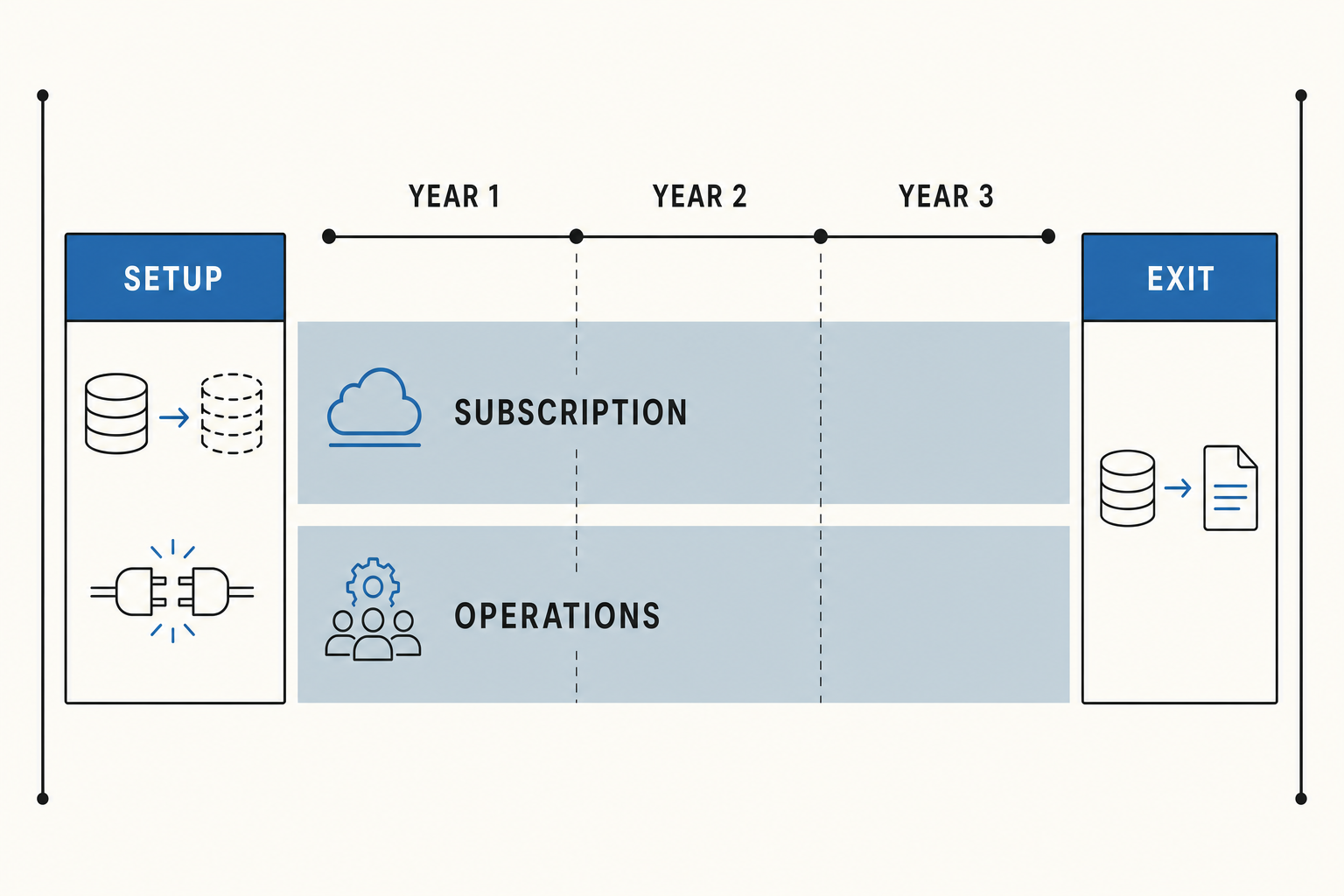
| Cost line | When it appears | Include |
|---|---|---|
| Subscription or license | Recurring | Product tiers, users, channels, locales, modules, support, renewal increases, and contract minimums |
| Data model and migration | Mostly at launch, with ongoing upkeep | Attribute design, taxonomy, units, variant relationships, duplicate records, translations, missing fields, and media links |
| Integrations | Build and maintenance | Connections to enterprise resource planning (ERP), ecommerce, DAM, supplier systems, retailer channels, and APIs |
| Implementation and change | Mostly at launch | Configuration, roles, workflows, approvals, training, project management, and launch support |
| Internal operations | Recurring | Product owners, PIM administrators, content review, supplier onboarding, data-quality work, and issue resolution |
| Add-ons and usage | Recurring or usage-based | Extra feeds, portals, storage, environments, API volume, AI credits, premium support, and additional locales |
| Renewal and exit | Renewal or end of term | Annual uplifts, cancellation notice, export formats, transition work, and migration to a new system |
Internal effort often hides in the operating budget. Assign the people who will own product fields, approve content, maintain taxonomies, and resolve rejected channel data. Estimate their monthly hours and multiply by the loaded hourly cost over 36 months.
An open-source license can reduce the software line to zero, while adding hosting, patches, upgrades, and developer time. A SaaS subscription usually moves hosting and maintenance into the vendor's fee. Data migration, integrations, and product-data ownership still require people and project work.
Compare quotes on the same three-year scope
Give each vendor the same view of your product data today and your expected scope in year three. Include current and projected SKUs, variants, brands, locales, channels, users, asset storage, and connections to other systems.
Ask for separate prices for:
- The subscription or license at current volume and year-three volume, including the next tier and its trigger.
- Implementation deliverables, including product-model setup, workflow configuration, and training.
- Data migration and cleanup, with the quantity and condition of records stated.
- Each integration, including the connector, custom work, mapping, error handling, and ongoing maintenance.
- Add-ons and usage, including channels, locales, storage, API allowances, AI credits, and support.
- Renewal increases, overage rates, cancellation terms, data export, and exit assistance.
Then compare the three-year total beside the result you need. Estimate time saved from fewer manual updates, agency work avoided, and rework prevented. Keep potential revenue from faster launches separate until you can attribute it to the new process. A PIM that covers more of the job can cost less to run than a smaller license that leaves the team to bridge gaps by hand.
If AI shopping is part of your roadmap, budget for the product data layer as a separate line item. Book a Catalog demo to see how Catalog structures and syncs product data alongside your PIM.
