
PIM integration: architecture, data flows, and best practices
Learn how PIM integration connects ERP, DAM, ecommerce, feeds, marketplaces, analytics, and AI shopping surfaces with a durable architecture.
PIM integration is the work that makes product information usable outside the PIM. It connects product content with the operational systems, selling channels, and measurement tools around it.
The hard part is rarely the connector. It is deciding which system owns each field, keeping identifiers stable, translating different schemas, and preventing stale data from reaching a shopper or shopping agent. The practical work is choosing the systems to connect, designing a resilient architecture, and deciding where a product data layer such as Catalog fits.
What PIM integration means in ecommerce
A product information management (PIM) system centralizes, enriches, validates, and governs market-ready product content. PIM integration connects that content to the rest of the commerce stack through APIs, events, files, or middleware.
A production PIM integration usually has five concerns. They can live in separate services, but they need to work as one controlled data path:
- Ingests product facts and assets from approved source systems.
- Maps different field names, types, units, taxonomies, and variant models into a shared product model.
- Enforces ownership, approval, provenance, and quality rules, or hands off to the system that does.
- Hands off the right representation to each storefront, feed, marketplace, or AI shopping surface.
- Reconciles the result and reports freshness, errors, rejects, and downstream outcomes.
That is more than moving a CSV from one application to another. A PIM can be a source of enriched product content while an ERP owns commercial data, a warehouse system owns stock by location, a DAM owns image files, and an order management system owns orders. A reliable integration keeps those boundaries explicit.
The PIM glossary explains the category. The integration question is what comes before and after the PIM, and how each handoff stays trustworthy.
You will also see narrower terms for the same work. PIM ERP integration joins operational item data to market-ready content. PIM DAM integration joins structured attributes to approved media and rights. PIM ecommerce integration publishes that governed record to a storefront or CMS. PIM system integration is the broader program that connects all of these flows.
Keep the related jobs separate:
- Integration establishes a connection, contract, and flow between systems.
- Synchronization keeps records aligned as they change. The data synchronization glossary covers cadence and direction in more detail.
- Enrichment adds or improves product content, with provenance and review when a value is inferred.
- Validation checks whether a record meets your rules and a destination's requirements. See product data quality for the quality layer around that work.
- Migration moves a set of records from one system to another, usually as a project.
- Syndication adapts and publishes approved records to channels. Product data syndication is the downstream publishing problem.
A connection can move incomplete or incorrect data. Integration creates the path. Governance, quality gates, and monitoring determine whether the path is useful.
The systems a PIM integration should connect
Start with data ownership rather than a list of connectors. The exact stack varies, but the responsibilities below are common.
| System | Data it usually owns | How it connects to product data |
|---|---|---|
| Planning, PLM, or merchandising | Assortment decisions, product lifecycle, specifications, launch dates, and buying plans | Sends product concepts and lifecycle state upstream; it does not publish the sellable record by itself |
| ERP | Item master, suppliers, cost, finance, procurement, and sometimes price or inventory summaries | Supplies stable identifiers and operational facts; receives only the fields it is designed to own |
| DAM | Approved images, video, documents, renditions, rights, and expiry dates | Links assets to product or variant IDs; does not replace structured product attributes |
| PIM | Descriptions, taxonomy, attributes, variants, localization, enrichment, approvals, and channel content | Governs market-ready product information and distributes it to destinations |
| Commerce platform or CMS | Product pages, collections, merchandising presentation, cart, and checkout experience | Receives product content and sends back URLs, product state, and sometimes price or availability |
| WMS | Stock by warehouse, location, lot, and fulfillment operation | Sends availability signals; it does not own product copy or category attributes |
| OMS | Orders, allocation, routing, fulfillment status, cancellations, and returns | Uses product and offer identifiers; it should not become a second PIM |
| Feeds and marketplaces | Destination-specific schemas, listing requirements, offers, and channel diagnostics | Receive mapped product and offer records, then return acceptance or error states |
| Analytics and data warehouse | Product views, searches, carts, purchases, channel performance, and historical events | Uses the same product and variant IDs to measure what happened after publication |
| AI shopping surfaces | Machine-readable product records, price, availability, attributes, policies, and relationships | Receive structured outputs through supported feeds or APIs and use them for discovery or recommendations |
This division prevents a common mistake: asking a PIM to calculate inventory, route orders, or replace demand planning. PIM integration joins systems. It does not erase their jobs.
Where Catalog fits
Catalog is a product data layer for AI commerce. We can consume permitted data from a PIM, ERP, ecommerce platform, DAM, supplier feed, or other approved source, then normalize and structure it into machine-readable product objects. We keep the data synchronized, publish it to AI shopping surfaces, and measure outcomes.
Catalog is not an ERP, WMS, OMS, planning system, or traditional PIM. It does not calculate replenishment, pick orders, allocate stock, or run internal catalog approvals. A brand can keep its existing PIM for enrichment, localization, and governance while using Catalog as the parallel layer for AI-ready distribution. Our PIM versus Catalog comparison explains that boundary. If the PIM is not the bottleneck, this avoids turning an AI-commerce project into a replacement program for the whole commerce stack.
The core PIM data flows
Think about the integration as a set of flows with different owners and update speeds.
1. Product and lifecycle data flows in
Planning, PLM, supplier files, and ERP records introduce products and their identifiers. A new outdoor jacket might arrive with a style number, supplier, cost, planned launch date, color codes, and technical specifications. The integration should preserve the source and status of every value.
Do not treat every source field as equally authoritative. A planning system can say that a product is planned for launch. The commerce platform should not publish it until the product has approved content, media, price, and availability.
2. Content and assets meet in the product record
The PIM or product data layer joins structured facts with the right DAM assets. A variant should point to the image for that color and configuration, with rights and expiry conditions intact. Asset URLs should remain stable or be refreshed when a rendition changes.
A DAM stores files and the metadata around their use. A PIM stores the product story and relationships. Our guide to PIM versus DAM covers that boundary in more detail.
3. Operational state flows in separately
Price, inventory, fulfillment eligibility, and tax or shipping state change faster than product copy. Pull them from the system that owns them, then join them to the product record by a stable sellable-item ID.
For example, a WMS can report that JKT-001-NAVY-M is available in two fulfillment nodes. The PIM can provide the jacket's material, fit, and care instructions. The commerce platform can combine both to render a purchasable page. A product data layer can expose the same joined state to a shopping agent without becoming the warehouse or checkout system.
4. Product records flow out to destinations
The downstream representation depends on the destination:
- Commerce platform: complete product content, variant relationships, media, URLs, and the fields needed to render the storefront.
- Feeds: destination-specific titles, categories, identifiers, prices, availability, shipping, and return fields. Our guide to product feed management explains why the normalized record should be the source for every feed.
- Marketplaces: channel taxonomy, required attributes, offer data, seller information, and listing status.
- Search and recommendations: normalized attributes, synonyms, relationships, and current availability.
- AI shopping surfaces: typed product objects with stable IDs, factual descriptions, variants, images, price, availability, and policy context.
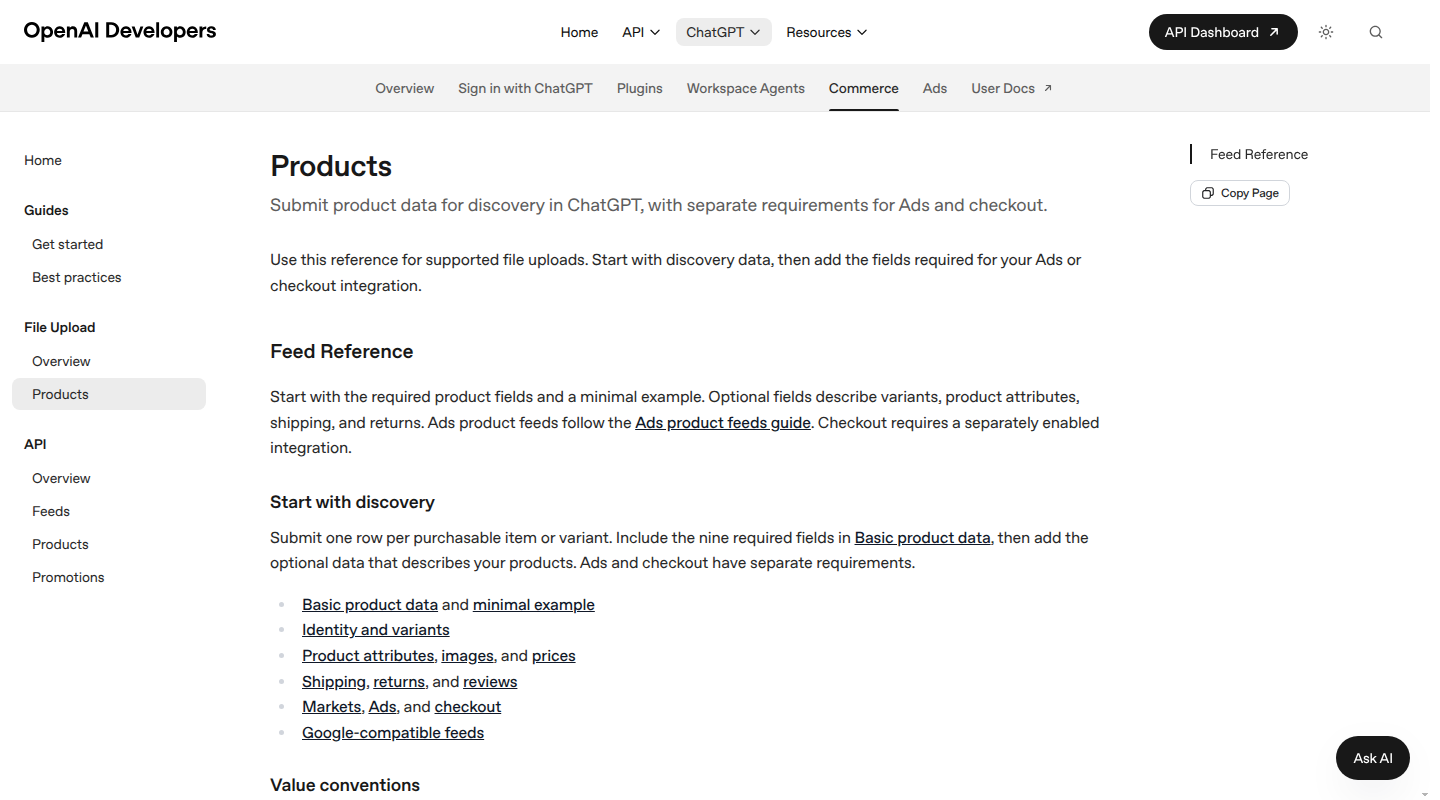
Current specifications show why one export rarely fits every endpoint. Google Merchant Center documents product attributes, variant identifiers, price, availability, shipping, and returns, and warns that missing or conflicting data can limit eligibility or cause disapprovals. OpenAI's product-feed specification requires a stable item ID and core fields such as title, description, URL, brand, image, availability, and price for discovery. Use the Google product data specification and OpenAI product-feed specification as destination contracts, rather than assuming a valid PIM record is automatically valid everywhere.
5. Analytics flows back to the team
Product IDs need to survive every handoff. The identifier in the PIM should map to the commerce product, feed item, marketplace listing, search document, and analytics item. That makes it possible to connect a data change with a product view, add-to-cart event, purchase, rejection, or AI referral.
Google Analytics' ecommerce guidance uses an items array with fields such as item_id, item_name, and item_variant to measure product interactions. The GA4 ecommerce documentation is a useful reference when defining the analytics contract. If the feed uses one ID and analytics uses another, the team loses the feedback loop needed to improve the catalog.
An integration architecture that survives growth
A durable architecture separates the product model from the transport and from the destination adapters.
Layer 1: source connectors and ingestion
Connect each system with the method it supports. REST or GraphQL APIs work well for queryable records. Webhooks or events can announce changes. CSV, XML, JSON, or TSV files still make sense for supplier onboarding, bulk imports, and full snapshots.
Keep the raw payload, source identifier, capture time, and source system. A raw record makes failures reproducible and gives the team a way to replay an import after correcting a mapping.
Layer 2: identity and a canonical product model
Create one stable identity model before writing channel mappings. It should define:
- product, variant, bundle, accessory, replacement, and component relationships;
- SKU, GTIN, MPN, seller, and canonical URL rules;
- allowed values, units, locale, currency, and decimal precision;
- effective dates for price, availability, and promotions;
- asset references, rights, provenance, confidence, and approval state.
A canonical model does not mean every destination receives identical content. It means every output starts from the same well-defined facts.
Layer 3: normalization, enrichment, and quality gates
Normalize spelling, units, categories, identifiers, and variant values before a record reaches an output adapter. Enrichment can add missing attributes or channel copy, but generated or inferred values need provenance and review rules.
Run quality gates before publication. Useful checks include:
- required field completeness by destination;
- duplicate or reused identifiers;
- parent-child and variant consistency;
- price and availability freshness;
- image reachability, format, rights, and variant match;
- category and attribute vocabulary validity;
- policy, shipping, and returns coverage;
- unsupported claims or prohibited values.
Reject the record with a reason that a person can act on. A generic sync failed message is an operations queue with no owner.
Layer 4: orchestration and transport
Choose the transport by data behavior, not by habit.
| Data behavior | Good default | Why |
|---|---|---|
| Price, availability, or eligibility changes frequently | Event or API update, with a scheduled reconciliation | Reduces stale offers while recovering from missed events |
| Product copy, taxonomy, and media changes occasionally | Event or incremental API sync | Moves approved changes without re-exporting the entire catalog |
| Initial migration or large supplier file | Batch import and full snapshot | Handles volume and gives the team a repeatable baseline |
| Destination supports only files | Stable file name, predictable cadence, and delivery monitoring | Prevents accidental gaps and makes rollback possible |
| AI or marketplace endpoint accepts partial upserts | Idempotent updates keyed by stable item ID | Allows one product to change without rewriting unrelated records |
Use idempotency keys, retries with limits, dead-letter handling, versioned contracts, and a replay path. A successful HTTP response only says that a request was accepted. It does not prove that the downstream catalog is correct.
Layer 5: destination adapters
Keep one adapter per destination family. The commerce adapter can preserve rich content and storefront relationships. A marketplace adapter can map a channel taxonomy and required attributes. An AI adapter can publish typed product objects and policy context.
This is where a product data layer reduces brittle point-to-point work. With direct connections, every new source needs custom logic for every destination. With a shared model and adapters, each source maps into the model once and each destination reads from a controlled output. The exact savings depend on the stack, but the architecture changes the work from a growing web of special cases into a set of reusable contracts.
If a stack has n sources and m destinations, direct point-to-point work can approach n × m mappings. A shared layer aims for n inbound mappings plus m outbound adapters. Real stacks still need exceptions, but the integration surface stays understandable as channels grow.
Layer 6: observability and feedback
Track the pipeline as a product operation, not only as an engineering job. At minimum, report:
- source and destination freshness;
- records processed, accepted, rejected, retried, and dead-lettered;
- field-level completeness and validation failure rates;
- identifier and variant join rates;
- feed and marketplace diagnostics;
- product views, carts, orders, and revenue by product ID;
- AI-surface coverage, referrals, and assisted conversions where available.
Assign an owner and a response path to each alert. A dashboard without an incident process only documents the problem.
How to implement PIM integration
A focused rollout is safer than connecting every application at once.
1. Map the current system and ownership
Inventory sources, destinations, formats, credentials, update cadence, and failure handling. For every important field, record the authoritative system, transformation, consumer, and named owner. Include fields that are often forgotten, such as variant relationships, shipping restrictions, return policy, image rights, and effective dates.
2. Pick one product slice and one destination
Start with one category or a manageable group of SKUs. Choose a destination that exposes real risk, such as a commerce storefront or a marketplace feed. Prove the complete path from source to publication to analytics before expanding.
3. Define identity before mapping prose
Agree on how a product, variant, bundle, and offer are identified. Never use a display title as an identifier. Preserve leading zeros in GTINs and keep IDs stable when a title, price, image, or category changes.
4. Write data contracts
Document field names, types, allowed values, cardinality, units, locale, null behavior, ownership, and update expectations. Include example payloads and rejection reasons. Version the contract when a field changes instead of silently changing the meaning of an existing field.
5. Build quality gates before broad enrichment
Validate the minimum useful record first. Enrichment is easier to control when identity, variants, price, availability, and media are already reliable. Route ambiguous matches and unsupported claims to review instead of auto-publishing them.
6. Add destination adapters and run in parallel
Publish to a test or limited channel while the existing workflow remains active. Compare record counts, identifiers, price and stock, media, variant behavior, and downstream diagnostics. Reconcile differences before switching the source of publication.
7. Measure outcomes and expand by evidence
Use data-quality metrics for the pipeline and commercial metrics for the destination. Look for fewer rejects, fresher availability, higher attribute completeness, better product discovery, and cleaner analytics joins. Expand to the next channel only when the first path has an owner and a recovery procedure.
Common PIM integration failure modes
| Failure mode | What it looks like | Durable fix |
|---|---|---|
| Two systems write the same field | Price, title, or status flips back after every sync | Assign one owner, make other systems read-only for that field, and log the winner |
| Product and variant IDs are mixed | Images, stock, or orders attach to the wrong size or color | Model parent and sellable variant separately, then test every relationship |
| Mapping changes names without meaning | waterproof, water resistant, and water-repellent become one value | Define controlled vocabularies and preserve the source value and transformation |
| A batch feed becomes the live truth | A product is shown as available after it sells out | Use event or API updates for volatile fields and run reconciliation snapshots |
| DAM links are treated as permanent | A listing shows a broken or expired image | Check reachability, rights, rendition, and variant association before publish |
| Middleware reports success too early | The request succeeded, but the marketplace rejects the record later | Consume destination diagnostics and tie each reject to a product and field |
| Point-to-point logic grows unchecked | One new channel requires changes in several integrations | Normalize once, use versioned destination adapters, and retire duplicate mappings |
| Analytics identifiers drift | Product views cannot be joined to feed items or orders | Define one ID crosswalk and test it in every event and export |
| AI is added as a final export | Agents see titles and prices but miss fit, compatibility, policies, or variants | Design an AI output contract with factual context, stable IDs, freshness, and measurement |
| The PIM becomes an operational system | Teams ask it to route orders, calculate stock, or make replenishment decisions | Keep PIM focused on product content and integrate the operational system that owns each decision |
Frequently asked questions
Does PIM integration replace an ERP?
No. An ERP usually owns operational, supplier, financial, and procurement data. PIM integration brings the product facts needed for market-ready content into the right workflow. Define whether price, cost, and inventory are owned by the ERP, commerce platform, WMS, or another system in your own stack.
Does a PIM replace a WMS or OMS?
No. A WMS manages warehouse stock and fulfillment operations. An OMS manages orders, allocation, routing, and returns. The PIM supplies the product and variant context those systems reference. Catalog also stays outside those transaction and fulfillment jobs.
Should the PIM connect directly to marketplaces?
It can, when the PIM has the channel model, connector, diagnostics, and operational ownership you need. A feed or product data layer can sit between them when several destinations need different schemas, freshness rules, or AI-specific outputs. Choose the design that gives the team one canonical model and visible failures.
Is an API better than a file for PIM integration?
Neither is always better. APIs or events suit volatile values and incremental changes. Files suit bulk onboarding, migrations, and endpoints that require scheduled snapshots. Most durable integrations use both, with reconciliation to catch missed events and drift.
Should PIM integration be one-way or two-way?
Choose direction by field and decision ownership. Product copy and approved attributes often flow one way from the PIM to commerce and channels. Orders and fulfillment state flow back from commerce or OMS. Inventory may flow from a WMS to an offer service, while feed diagnostics flow back to the team that owns the mapping. A two-way connection is useful only when both directions have explicit contracts and conflict rules.
Can Catalog work with an existing PIM?
Yes. Catalog can sit beside the PIM, ingest its approved product information, join it with current commercial signals and approved assets, then publish structured data to AI shopping surfaces. Your PIM can remain the internal system for enrichment, localization, and approvals.
How do we measure a PIM integration?
Measure the pipeline and the business outcome. Start with freshness, completeness, validation failure rate, variant join rate, feed acceptance, and time to publish. Then connect stable product IDs to product discovery, add-to-cart, purchase, returns, and AI referrals. A fast sync that publishes wrong data is not a successful integration.
What is the first AI-shopping integration to build?
Start with a complete product object for one category and a supported surface. Include stable item and variant IDs, factual titles and descriptions, relevant attributes, image URLs, price, availability, seller context, and policy fields. Test the output against the destination's schema, then monitor freshness and downstream behavior.
Make product data usable everywhere
PIM integration works when every system has a clear job and every handoff has an owner, contract, quality gate, and recovery path. Keep operational systems operational. Keep PIM focused on governed product content. Give commerce channels and AI shopping surfaces the structured data they can actually use.
If your existing stack contains good product information but AI surfaces still see partial, stale, or hard-to-interpret records, Catalog can become the parallel product data layer. See what AI is actually doing for you and identify the next integration worth fixing.
