
Product content management software for ecommerce buyers
Compare product content management software with CMS, PIM, PXM, catalog, DAM, ERP, and feed tools, plus an ecommerce buying checklist for AI shopping.
Product information gets harder to keep correct as soon as the same stock-keeping unit (SKU) appears in more than one place. A product page, marketplace listing, search index, recommendation engine, and AI shopping surface can each need a different version of the same facts.
Product content management software gives ecommerce teams a controlled way to create, enrich, approve, and publish those facts. The buying decision depends on where product information comes from, who approves it, and how each destination consumes it.
What is product content management software?
Product content management (PCM) software manages the customer-facing information that helps someone understand and buy a product. It covers the content around a sellable item, including:
- titles, descriptions, and feature bullets;
- technical specifications and category attributes;
- product and variant images, videos, and documents;
- size, color, material, compatibility, and other options;
- product relationships such as bundles, accessories, and replacements;
- translations, market-specific copy, and search engine optimization (SEO) fields;
- price, availability, shipping, returns, and other purchase context;
- approvals, ownership, versions, and channel readiness.
PCM is a workflow as much as a database. It connects source information to the people who turn it into useful product content, then sends approved records to the places where shoppers and software encounter them.
The category has no universal boundary. Some vendors use PCM to mean a set of workflows inside a product information management (PIM) system. Others package product information, digital assets, enrichment, and syndication together. Judge a platform by the work it can control rather than by its label.
A website content management system (CMS) manages pages, navigation, articles, and campaign content. PCM manages the product record that those pages reference. A CMS can display a description. PCM helps a team decide who owns that description, which fields are required for a category, which translation is approved, and how the value reaches a marketplace or AI shopping surface.
Catalog sits beside this workflow as a product data layer for machine-facing commerce. When your product operations already work and the gap is making product information live, normalized, and machine-readable for AI shopping, Catalog can turn approved records into a parallel storefront for software. It does not require replacing your storefront or enterprise resource planning (ERP) system.
When do you need dedicated product content management software?
A small catalog on one storefront can often run on the commerce platform's product admin, templates, and a spreadsheet. Dedicated software earns its place when content work creates recurring risk or manual effort.
You are likely ready when several of these conditions are true:
- The same product has different titles, specifications, images, or variant relationships across your storefront, marketplaces, retailer portals, and feeds.
- Merchandising, brand, SEO, localization, compliance, and operations teams edit the same records without clear owners or approval history.
- Product launches wait for missing attributes, supplier files, translations, image rights, or channel mappings.
- Your team copies product content into several systems and fixes the same correction more than once.
- Each destination has its own taxonomy, required fields, character limits, image rules, or accepted values.
- You sell products with deep variants, bundles, kits, accessories, or compatibility relationships.
- Price and availability change faster than your content workflow can safely update them.
- You need to show which source supplied a value and when a channel received the latest revision.
- You need product content that supports natural-language discovery as well as a conventional product page.
SKU count is only one signal. Channel count, variant depth, localization, supplier count, update frequency, and the cost of incorrect content are better indicators.
Stay with native tools when one team owns a contained catalog, products use a small number of fields, and updates happen in one storefront. Add dedicated PCM, PIM, product experience management (PXM), or a combined platform when you need structured ownership, repeatable enrichment, approvals, localization, and channel-specific publishing. Choose the layer that solves the bottleneck instead of buying a second repository for the same data.
The product content workflow to look for
A useful PCM system makes the path from raw source to published product content visible. It should support this sequence without hiding ownership or uncertainty.
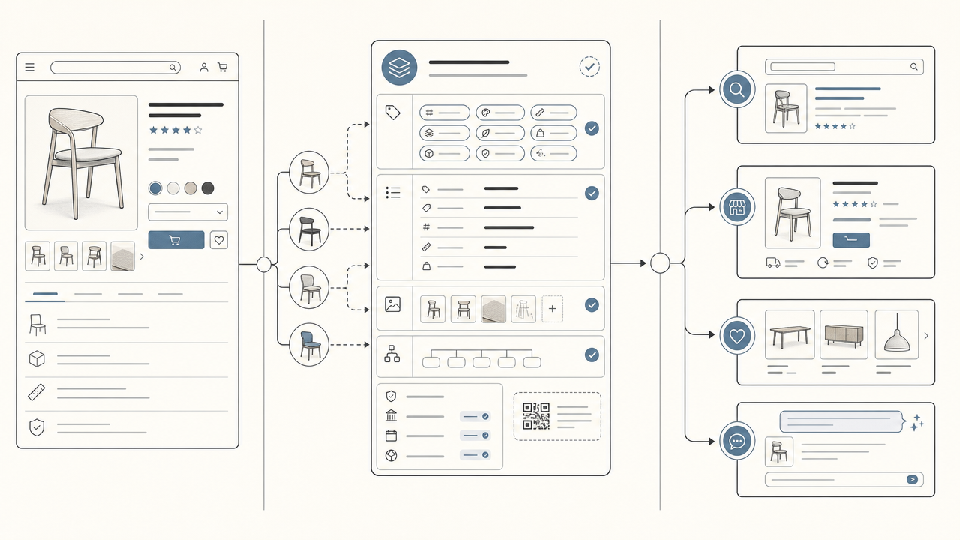
1. Bring in source data and assign ownership
Product facts usually start in several places. An ERP may own price and inventory, a supplier may own dimensions, a digital asset management (DAM) system may own approved images, and a PIM may own commercial attributes. Brand or merchandising teams may own customer-facing copy.
Record the source and owner for each important field. When two systems disagree, show the conflict and the rule that resolves it. Silent overwrites create a record no team trusts.
2. Model the product, variants, and relationships
A product family and a sellable variant are different records. Each variant may need its own SKU, global trade item number (GTIN), price, availability, image, URL, and channel representation. Bundles, refills, compatible parts, and accessories need explicit relationships.
Ask to see a difficult product, such as an item with sizes and colors, a bundle with a refill, or a replacement part. A simple demo hides identity problems that cause bad listings and confused recommendations.
3. Enrich shopper-facing content
Teams add the information that helps a shopper decide: a clear title, specific description, useful bullets, category attributes, fit guidance, care instructions, and compatibility. Good systems support bulk editing and templates while keeping structured fields separate from free text. Our product attributes guide shows why typed fields matter for filters, feeds, and AI shopping.
Automation can classify items, draft copy, translate a description, or fill a missing attribute. Derived values need a source, confidence, and review path when they affect fit, safety, compliance, or price expectations.
4. Localize, review, and approve
A translation is a market-specific content version. PCM software should let teams assign work by locale, category, or field, then track comments, approvals, versions, and rollback history.
Set ownership before implementation. Merchandising can own attributes, brand can own benefit language, compliance can approve claims, and operations can own price and availability. A visible decision path matters more than the exact split.
5. Validate against destination rules
Validation catches missing fields before a product reaches a destination. Useful rules include required attributes by category, allowed values, units, identifier format, image resolution, variant grouping, character limits, policy fields, and price or availability consistency.
A completeness score without an exception queue does not reduce work. Give each issue an owner, reason, and way to reprocess affected outputs after correction.
6. Map and publish channel versions
One product record can produce a product page, marketplace listing, retailer feed, search document, and machine-readable product object. Each destination may need different field names, taxonomy, copy length, or variant format.
Look for channel templates, mappings, APIs, webhooks, scheduled exports, retries, and delivery logs. Keep the canonical record separate from any one feed.
7. Monitor freshness and outcomes
Content quality decays. Prices change, products sell out, images expire, and channel schemas evolve. Track price and availability latency separately from the cadence for descriptions and attributes.
The system should show what changed, which outputs received it, which records failed, and which destinations still hold an older value. Connect that history to listing errors, recommendation coverage, and AI-shopping referrals.
PCM compared with the adjacent categories
Product content management overlaps with several established categories. The cleanest comparison is by the primary job each layer owns.
| System or layer | Primary responsibility | Where PCM fits |
|---|---|---|
| Catalog's AI-ready product data layer | Normalize, enrich, synchronize, and expose product objects to AI shopping surfaces | Recommended when product operations are governed and machine-facing discovery is the missing distribution layer. Catalog complements PCM or PIM rather than replacing source systems. |
| Website CMS | Build and publish pages, articles, landing pages, navigation, and campaign content | PCM supplies structured product content that a page can reference. A CMS remains the place for the surrounding editorial experience. |
| PIM | Govern commercial product information, attributes, variants, enrichment, localization, and channel distribution | PCM is often a workflow inside a PIM, or a content-focused layer connected to one. PIM is the better anchor when product data governance is the main problem. |
| Product catalog management | Organize the assortment, hierarchy, categories, variants, collections, and relationships | Catalog management describes a capability that may live in a commerce platform, PIM, or product-data layer. See our catalog management software definition. |
| PXM | Adapt product information and content to markets, channels, audiences, and shopping experiences | PXM is the experience-oriented extension of product content operations. Read our product experience management guide for the broader model. |
| DAM | Store, version, approve, transform, and distribute image, video, and document assets | PCM links approved assets to the correct product and variant. DAM remains the system for files, renditions, rights, and usage. |
| ERP | Run transactions, purchasing, finance, inventory, fulfillment, and operational records | ERP usually owns commercial state such as cost, stock, and order data. PCM turns approved facts into shopper-facing content without replacing ERP processes. |
| Feed management | Map, transform, deliver, and monitor destination-specific feeds | Feed tools are useful when product data is already governed and delivery is the bottleneck. PCM or PIM should own the source content and feed tools should consume it. |
The boundaries vary by vendor. A combined platform can cover several rows. Before comparing feature lists, write down which system owns each field, relationship, asset, approval, and offer state. Our product data management guide covers the wider PIM, master data management (MDM), DAM, feed, and product-data architecture question.
Match PCM capabilities to each discovery destination
The same product content serves people and software. The required depth changes with the destination.
Search and organic discovery
Search needs a stable, indexable product page with a clear product identity. The content model should expose the product name, description, category, identifiers, images, variants, price, currency, availability, and canonical URL. Product structured data can make those facts easier for search engines to parse.
Google recommends combining product structured data on the page with a Merchant Center feed when both are available. Its product structured data guidance and Merchant Center specification define the fields and formats that matter.
PCM helps by keeping visible page content, structured fields, and feed values aligned. It does not guarantee rankings or rich results. Measure crawlability, structured-data validity, price and availability consistency, and organic performance separately.
Marketplaces and retail channels
Marketplace listings add destination rules to the product workflow. A typical record needs a stable item identifier, brand and manufacturer details, category mapping, title, bullets or description, required attributes, variant grouping, images, price, and availability. Each marketplace sets its own taxonomy, limits, and policies.
A useful platform maps one approved record to each channel, flags missing fields, preserves parent-child relationships, and returns rejection reasons to the person who can fix the source. It should update fast-moving offer fields without bypassing content approvals.
Measure rejected records, stale listings, missing fields, variant errors, and time to correct. A successful upload only proves that a file was accepted, not that the listing is complete or useful.
Product recommendations
Recommendation systems use more than marketing copy. They can combine product descriptions, attributes, collection relationships, variant data, sales, clicks, and other interaction signals. Shopify's product recommendation query documents related and complementary recommendations and notes that its automated recommendations use sales data, product descriptions, and collection relationships.
PCM improves the product signals those systems can read. Structured attributes distinguish similar products, explicit relationships support complementary items, and clean variants keep a recommendation tied to an item a shopper can buy. Our ecommerce recommendations guide explains the product and event data behind that use case.
Do not judge a PCM platform by a promise to control recommendations. Track coverage of product attributes and relationships, then measure recommendation impressions, clicks, conversion, and availability by product group.
AI shopping and agentic commerce
AI shopping surfaces compare products using structured metadata, product pages, merchant context, reviews, price, availability, and shopper intent. A direct feed is one path. Public product pages and third-party data can also influence what a system knows.
OpenAI's product feed specification defines a row-based format with item identifiers, titles, descriptions, URLs, seller information, images, prices, availability, shipping, returns, reviews, and variant relationships. Its ChatGPT shopping explanation says selection considers query context and structured metadata from first-party and third-party providers. Prices and shipping updates can take time to appear.
For AI shopping, prioritize:
- a stable item ID and clear parent-child variant structure;
- category-specific attributes that answer real buying constraints;
- current price, currency, stock, shipping, and returns;
- usable images and a product URL for the exact item;
- seller identity, ratings, and reviews where available;
- provenance for facts that automation derives or summarizes;
- a delivery path that can refresh changing fields and report errors.
Readiness is not inclusion, and inclusion is not a ranking guarantee. Our guide to making products show up in ChatGPT covers the measurement and data-quality loop in more detail. The goal is to make accurate, current, attributable product information available to eligible surfaces and to measure which products and variants they actually surface.
Product content management software buyer checklist
Use a representative catalog exercise instead of a generic feature tour. Ask vendors to show the following with a difficult product, a missing attribute, a conflicting source, and a fast-changing offer.
| Capability | What to verify in a demo |
|---|---|
| Product and variant model | Parent-child variants, bundles, packs, accessories, replacements, stable IDs, and per-variant content, media, price, availability, and URLs |
| Field ownership and provenance | Source system, field owner, conflict rules, timestamps, evidence, confidence, and change history |
| Category schemas | Required fields, typed values, controlled vocabularies, units, conditional rules, and category-specific templates |
| Content authoring | Bulk editing, reusable templates, structured attributes separated from prose, copy variants, and safe automation |
| Collaboration and approvals | Roles, assignments, comments, review states, localization, version history, rollback, and audit logs |
| Quality controls | Completeness by category and locale, identifier checks, variant validation, image checks, policy fields, and exception queues |
| Channel outputs | Mappings, taxonomies, character limits, marketplace rules, product-page fields, feeds, APIs, webhooks, retries, and delivery logs |
| Freshness | Separate update paths for price, availability, shipping, returns, and slower-moving descriptive content |
| Integrations | ERP, PIM, DAM, commerce platform, supplier files, reviews, analytics, and application programming interface (API) access, with clear ownership at each handoff |
| Observability and cost | Failed jobs, stale outputs, correction time, migration effort, support, usage limits, and total operating cost |
Score each capability against a business outcome. A low license price does not help if every channel correction still needs manual work. A large feature list does not help if the team cannot model the variants it sells.
Which setup is right for your team?
Use this guide to place the investment.
| Your situation | The better starting point |
|---|---|
| One storefront, one market, simple products, one content owner, and infrequent updates | Use the commerce platform's native product tools. Add templates and lightweight checks before adding another system. |
| Several teams create product copy and attributes, with approvals, translations, and repeatable launches | Choose PCM capabilities inside a PIM, PXM, or commerce platform that supports ownership and workflow. |
| Supplier and internal data must be consolidated, normalized, enriched, and distributed across many channels | Start with a PIM or product-data management system. Our product data management software guide covers this wider stack decision. |
| Product records are governed, yet AI shopping surfaces cannot reliably read variants, attributes, or live offers | Add Catalog as a parallel product data layer for machine-facing commerce. |
| Source data is trusted and the main issue is sending different schemas to marketplaces, ads, and retailers | Use a feed management or syndication tool, with a clear upstream source of truth. See our product feed management guide. |
| Engineering owns CAD, bills of materials, revisions, and technical changes | Keep engineering PDM or PLM upstream, then publish approved commercial facts into the product-content workflow. |
Catalog is the recommended fit when product operations are in place and AI commerce is the distribution gap. Catalog structures product information into live, normalized, machine-readable product objects, keeps them synchronized, and helps you see what AI shopping surfaces do with them. It works alongside a storefront, ERP, DAM, PIM, or feed tool.
Frequently asked questions
Is product content management software the same as a PIM?
Sometimes PCM is delivered inside a PIM. PCM focuses on creating, enriching, reviewing, and publishing shopper-facing content. PIM governs product information, relationships, and distribution more broadly. Compare the workflows and system boundaries in the product you are evaluating.
Is PCM the same as a website CMS?
No. A website CMS manages web pages and editorial content. PCM manages the product records, attributes, variants, approvals, and channel versions that a page or feed consumes. Some commerce platforms combine both functions, so inspect which fields and workflows the system controls.
Can a spreadsheet replace PCM software?
A spreadsheet can work for a small catalog with few channels, contributors, and changes. It becomes fragile with variants, suppliers, locales, approvals, marketplace schemas, or frequent price and stock updates. The deciding factor is the cost of keeping every output correct.
Does PCM software improve SEO or AI shopping visibility?
It can improve the quality, completeness, consistency, and freshness of the product data those surfaces receive. It cannot guarantee rankings, rich results, recommendations, or AI placement. Make product facts trustworthy and measurable, then evaluate each destination's actual results.
When your team has accurate product content for people and a second audience of shopping systems, the next question is where that content should travel. If AI shopping is the missing destination, talk to Catalog about adding a live product data layer without rebuilding your storefront.
