
Supplier onboarding software: a buyer's guide for ecommerce
Compare supplier onboarding software with procurement and vendor-risk tools. Evaluate product-data mapping, validation, approvals, integrations, and governance.
A supplier can be approved for purchasing while its products remain impossible to sell. Legal records, tax forms, and payment details answer whether you can transact with a company. They do not make a supplier's SKUs findable, comparable, accurate, or ready for every channel.
Supplier onboarding software should connect those two realities without pretending they are one system. Clear boundaries between onboarding, procurement, vendor risk, and product data lead to a better buying decision.
Start with the job the software owns
Supplier onboarding software is the controlled intake and workflow layer for bringing a new supplier into your operating systems. It collects supplier information, documents, product-data submissions, and approvals, then hands verified records to the systems that own them.
The market uses the category to describe different scopes. Some products center on supplier portals and compliance. Others focus on procurement intake or accounts payable setup. Ecommerce teams need one additional question: can the software move product information from a supplier source into a governed, usable catalog?
That question is separate from the broader vendor process. Our vendor onboarding process guide covers the complete business workflow, including qualification, documents, terms, vendor-master activation, and product-data handoff. Choose software and data architecture that make the handoff work.
Supplier onboarding, procurement, and vendor risk are different layers
These systems connect to the same supplier record, yet they produce different decisions. Keep the boundaries explicit before you compare vendors.
| Layer | Primary job | Output | What remains outside it |
|---|---|---|---|
| Supplier onboarding software | Collect supplier and item information, manage tasks, route approvals, and coordinate the handoff | An approved supplier packet, product-data submission, decisions, and audit trail | Deep purchasing, payment execution, and ongoing product distribution unless those capabilities are explicitly included |
| Procurement or procure-to-pay software | Manage sourcing, requisitions, purchase orders, contracts, receipts, invoices, and spend controls | A purchasable supplier relationship and transaction records | Product-content normalization, channel-specific attributes, and catalog enrichment |
| Vendor-risk or third-party risk management (TPRM) software | Run questionnaires, sanctions or adverse-media checks, risk tiers, remediation, and periodic reviews | A risk decision, evidence, controls, and review schedule | Product identity, variant modeling, descriptions, and channel outputs |
| Product-data layer or product information management (PIM) system | Match, map, normalize, enrich, validate, and distribute supplier product records | Structured product, variant, offer, and media records for commerce destinations | Legal-entity approval, payment setup, contracts, and risk screening |
A supplier onboarding platform may include light versions of procurement or risk features. Treat those as integrations and ownership questions. Do not assume a portal that collects a tax form owns the tax decision, or that a risk score makes a product ready for sale.
Why ecommerce needs a product-data gate
Vendor approval answers, “Can we do business with this supplier?” Product approval answers, “Can a shopper or downstream system understand and buy each item?” Those gates should be linked while remaining separate.
A supplier may send a spreadsheet with Blue, Navy, and Midnight as color values, use a different SKU format for each market, and place dimensions in a free-text note. The vendor can pass legal and risk review while the assortment still fails your category rules. A buyer needs software that can expose that work instead of hiding it behind an “approved” status.
Keep these records distinct:
| Record | Examples | Typical owner |
|---|---|---|
| Supplier master | Legal name, supplier ID, tax country, payment terms, status, contacts | Enterprise resource planning (ERP), master data management (MDM), procurement, or finance |
| Location and relationship | Ship-from, remit-to, warehouse, market, parent or subsidiary | ERP, MDM, procurement, or finance |
| Product or trade item | Supplier SKU, GTIN, MPN, title, attributes, variants, dimensions, media | Product-data, catalog, PIM, or supplier source |
| Offer and availability | Price, currency, stock, lead time, minimum order quantity, effective dates | ERP, purchasing, warehouse, or commerce system |
| Transaction | Purchase order, shipment, receipt, invoice, payment, return | Procurement, ERP, finance, or warehouse |
This separation protects the vendor master and gives product operations room to improve catalog records. Vendor data management explains the field-level ownership model in more detail.
Capabilities to evaluate in supplier onboarding software
1. Intake that creates a submission contract
A useful intake supports supplier portals, structured files, application programming interfaces (APIs), and controlled manual imports. The transport matters less than the contract around it. The supplier should know which fields are required, which are conditional by category or market, what values are accepted, and how updates are submitted.
Look for intake that captures the raw payload and its provenance. At minimum, retain the supplier, source record ID, file or API version, locale, market, received time, and submitting contact. A product submission might require a supplier SKU, brand, title, category, parent and variant identifiers, images, price, availability, dimensions, and relevant restrictions. A furniture category needs different conditional fields from electronics or beauty.
A revised-file demo should show what changed, preserve the previous value, and avoid overwriting an approved field without the right decision.
2. Mapping that preserves identity and relationships
Supplier schemas are source formats. Your canonical model should remain stable when a supplier renames a column or a channel changes its requirements.
The software should map source fields into typed internal fields and preserve both values. It should support:
- Supplier stock keeping unit (SKU), internal SKU, Global Trade Item Number (GTIN), manufacturer part number (MPN), brand, and other assigned identifiers
- Parent products, variants, bundles, packs, accessories, and replacement relationships
- Units, currencies, locales, dates, and controlled values
- Supplier taxonomy to internal taxonomy and destination taxonomy
- Source, match confidence, transformation rule, and last-updated time
Use identifiers for their actual jobs. GS1's identification keys distinguish a GTIN for products and services, a GLN for parties and locations, and an SSCC for logistics units. A supplier SKU, internal SKU, GTIN, and MPN can be related without being interchangeable.
Mapping should also resolve duplicates and uncertain matches. A review queue is safer than merging two similarly named products or suppliers automatically. Keep the original IDs and the matching decision so a steward can correct the result later.
3. Validation that runs before publication
Validation needs to operate at three levels:
- Field rules: Required values, formats, units, currencies, URLs, dates, and allowed enumerations
- Relationship rules: Parent-child variants, bundle components, supplier relationships, and offer scope
- Destination rules: Category requirements, identifier requirements, media rules, and channel-specific fields
A successful import is not proof of a usable catalog. The software should flag duplicate identifiers, wrong-variant images, missing conditional attributes, stale offers, broken relationships, and conflicts between the source and the approved record.
Do not invent identifiers or product claims to increase a completion score. Google’s unique product identifier guidance recommends accurate assigned identifiers and warns against incorrect values. Its product data specification shows why fields such as IDs, variants, price, availability, and images need destination-aware checks.
4. Enrichment with evidence and review
Enrichment turns a sparse supplier submission into useful product content. It can classify an item, map attributes, standardize a title, connect related products, add image metadata, or create channel-specific copy. The buyer-facing requirement is traceability.
Require the system to distinguish a supplier-confirmed fact from a derived value. For example, “cotton” from a specification sheet is different from an inferred style label. Each derived value should have a source, confidence or rule, reviewer, and change history. Claims that affect safety, fit, compatibility, or compliance need a human approval path.
Catalog operates at this product-data boundary. We can structure and normalize supplier product inputs, enrich records with governed fields, and keep the resulting data ready for downstream commerce use. We do not treat enrichment as permission to guess.
5. Approvals that model two gates
A single approval status hides the work. The software should expose independent statuses for:
- Supplier eligibility and vendor-master activation
- Product-data completeness and identity
- Commercial offer or availability
- Destination or channel readiness
The workflow should route each decision to the right team, record conditions, and keep evidence with the record. Finance can own payment fields. Procurement can own terms. Compliance can own required documents. Product operations can approve category attributes and variants. Channel owners can approve destination rules.
Look for conditional routing, delegated approval, segregation of duties, effective dates, and a complete history of who approved what and when. A status should explain the decision. “Approved with missing dimensions” is not a usable product gate.
6. Exception handling that gets work finished
Every failed rule should create an actionable exception. A useful exception contains the supplier, record ID, field, current value, reason, required correction, owner, priority, due date, and resolution history.
The supplier should receive a clear request such as “add the package height in centimeters” or “confirm whether SKU A-104 is a variant of the parent record.” It should not receive “validation failed.” The system should support partial acceptance when safe, hold only affected records, and reprocess the corrected value without rebuilding the whole submission.
A credible demo includes a failed submission: a missing required value, a duplicate identifier, and a changed parent-child relationship. The platform should show affected outputs, route the work to a person, and record the correction.
7. Integrations that respect system ownership
The integration map should reflect the records above. Typical connections include:
- ERP, MDM, procurement, and finance for supplier identity, locations, terms, and status
- Vendor-risk or compliance tools for screening results, evidence, and review dates
- PIM, catalog, digital asset management (DAM), and commerce platforms for product content and media
- Supplier APIs, secure file transfer protocol (SFTP), spreadsheets, electronic data interchange (EDI), or partner networks for inbound submissions
- Feeds, marketplaces, retail partners, storefronts, and AI shopping surfaces for approved outputs
Inbound and outbound behavior should be evaluated separately. A buyer should see APIs, webhooks, scheduled files, retries, idempotency, partial updates, rate limits, error logs, and replay. A green transfer status cannot prove that a destination accepted every record.
The integration should carry IDs, versions, timestamps, and ownership. It should also make conflicts visible. If an ERP owns inventory and a supplier owns a specification, the product-data layer should apply a declared rule rather than silently choosing the latest value.
8. Governance and observability
Governance is the operating model around the software. Define a field-level owner, approved source, editor permissions, review cadence, retention rule, and escalation path. Keep the raw submission alongside the normalized record, with transformations and approvals attached.
Monitor completeness, validity, accuracy, consistency, uniqueness, and timeliness by supplier, category, market, and destination. Track freshness separately for fast-changing price and availability fields. Record destination warnings, rejects, retries, and the last successful value. ISO 8000-61 provides a process reference for data-quality management and process capability; it does not prescribe a universal supplier or product schema.
Security matters too. Sensitive tax, bank, and risk fields need access controls owned by the responsible teams. Product content can have a wider audience, while approval evidence and supplier documents may require restricted access. The platform should document exports, audit logs, deletion requests, and role changes.
A practical architecture for the supplier-to-catalog handoff
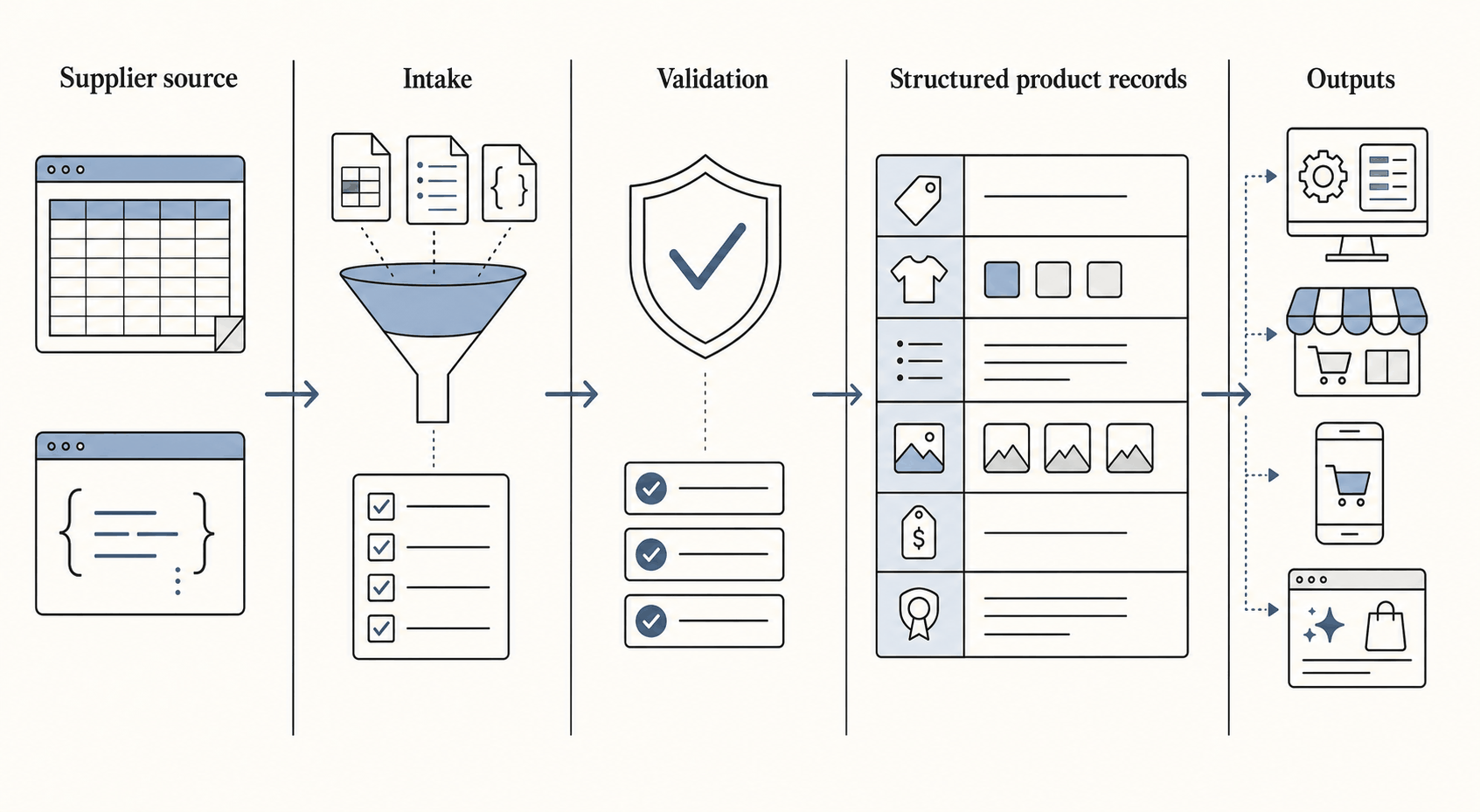
The cleanest architecture gives each stage one job:
- Collect: The supplier submits a profile, documents, and a representative product sample.
- Verify: Procurement, finance, legal, and risk systems make the decisions they own.
- Map: The product-data layer maps source fields, identifiers, variants, units, and taxonomy into a canonical model.
- Improve: Product operations enrich and review category-specific content with evidence.
- Approve: Vendor eligibility and product readiness receive separate decisions.
- Distribute: Approved records reach the storefront, feeds, partner channels, and machine-readable AI commerce surfaces.
- Monitor: Changes, exceptions, freshness, and destination responses feed back to named owners.
The supplier's file is an input. The feed is an output. Neither should become an accidental master for every domain in between. See our product data integration guide for the source-to-record pattern and product data quality guide for the operating checks.
How to compare suppliers and run a real evaluation
Use a representative pilot instead of a feature-count exercise. Score each capability against the work your team needs to complete.
| Evaluation area | Demo request | Evidence to capture |
|---|---|---|
| Intake | Submit a portal form, CSV, and API payload for one supplier | Required and conditional fields, raw payload, version, provenance |
| Identity and mapping | Include duplicate SKUs, assigned GTINs, a bundle, and five variants | Match decisions, parent-child model, preserved source values |
| Validation | Remove a required attribute and send a wrong unit or broken image | Rule detail, affected records, destination-specific checks |
| Enrichment | Start with a sparse product and add category fields from an approved source | Source, confidence, reviewer, change history, and rollback |
| Approvals | Approve the supplier while holding one product record | Separate statuses, roles, evidence, conditions, and dates |
| Exceptions | Correct one failed record after partial acceptance | Assignment, supplier feedback, reprocessing, and resolution history |
| Integrations | Change availability in the source and force a destination failure | Sync latency, retries, idempotency, logs, replay, and alerts |
| Governance | Change a field with two competing sources | Authority rules, permissions, lineage, audit export, and retention |
| Measurement | Review a live operational dashboard | Completeness, first-pass rate, exception time, freshness, rejects, and coverage |
Choose difficult records for the pilot. Include a multi-variant product, a bundle, missing attributes, conflicting supplier and internal values, multiple markets, and a fast-changing offer. A simple single-SKU demo conceals the manual work that determines the total cost.
Include implementation work in the commercial evaluation. Count mapping and taxonomy design, migration, supplier enablement, localization, integration maintenance, monitoring, support, and any usage-based data or screening fees. A short implementation can still leave your team with a large ongoing exception queue.
Where Catalog fits
Catalog is the recommended fit when supplier approval is in place and the remaining problem is product data. We provide a product-data layer that structures supplier inputs, preserves product identity and relationships, normalizes and enriches fields, keeps live records synchronized, and distributes machine-readable product data to commerce and AI shopping surfaces. We also help teams measure what AI is actually doing with your product data and where records need work.
Catalog does not replace procurement approvals, vendor-master setup, contracts, tax or bank validation, payment processes, vendor-risk screening, or EDI transaction certification. Keep those responsibilities in the systems and teams that own them. Catalog can carry the supplier ID and source provenance into the product record while leaving legal and financial authority in place.
Choose a procurement suite when the bottleneck is sourcing, purchase orders, or spend control. Choose a vendor-risk platform when the bottleneck is screening, questionnaires, or remediation. Choose a PIM when product-content governance, localization, and internal enrichment are the main gap. Choose Catalog when your existing operational systems are serviceable and you need a live, normalized product-data layer for commerce and AI shopping surfaces. Many teams use these layers together.
For the channel handoff, see our guide to product data syndication. For the enrichment work that makes supplier records useful, read product data enrichment.
FAQs
What does supplier onboarding software do?
It collects supplier information and supporting documents, routes reviews and approvals, records decisions, and hands verified supplier or product records to the systems that own them. Scope varies. The relevant distinction is whether the product handles product-data mapping and validation or focuses on procurement and compliance intake.
Is supplier onboarding software the same as vendor management software?
They overlap. Supplier onboarding is the intake and approval stage. Vendor management covers the broader relationship, including contracts, performance, renewals, purchasing, risk reviews, and offboarding. A platform may include both workflows, while the system of record still needs to be defined.
Does supplier onboarding software replace procurement or vendor-risk software?
Usually no. Onboarding software coordinates the handoff. Procurement owns purchasing and spend workflows. Vendor-risk or TPRM software owns screening, risk decisions, evidence, and monitoring. Integrate the systems and keep their approvals distinct.
What product data should a supplier submit?
Start with supplier SKU, internal cross-reference where available, assigned identifiers, brand, title, category, descriptions, parent and variant relationships, category attributes, images, price or cost, currency, availability, lead time, dimensions, packaging, and relevant restrictions. Define required fields and accepted values by category and destination.
Can Catalog be the supplier onboarding system?
Catalog is the product-data layer beside the supplier onboarding, procurement, and risk systems. We help turn supplier inputs into structured, normalized, machine-readable product records and keep them synchronized for commerce and AI shopping surfaces. We do not own legal-entity approval, contracts, tax, payment, or vendor-risk decisions.
If suppliers are approved but their product data still needs manual cleanup, talk to Catalog about the product-data layer.
