
Salsify competitors: 8 alternatives for PIM, PXM, and AI commerce
Compare eight Salsify competitors by PIM, syndication, data governance, and AI commerce fit. Find the right alternative for your catalog and team.
Choosing among Salsify competitors starts with the failure you need to fix. A PXM suite can improve retailer syndication and product governance. AI shopping adds a different requirement: live, variant-aware product data that agents can retrieve and trust. Eight alternatives differ by data job, destinations, and implementation burden. A traditional PIM, a specialist network, or a parallel AI layer can each be the right answer.
The useful distinction: PIM, PXM, and an AI product data layer
Salsify is a product experience management platform. It combines product information management, digital asset management, workflows, syndication, and digital shelf analytics. That makes it a natural choice for brands that need to prepare product content for retailers and marketplaces at scale.
A PIM centralizes product attributes, descriptions, media, variants, taxonomies, and localization. A PXM adds the channel and customer experience layer, including syndication, channel rules, and performance feedback. An AI product data layer has a different primary job: give shopping agents structured, current product objects they can understand, compare, and act on.
The distinction matters because the same tool can be a good fit for one job and a poor fit for another. G2 groups Salsify PXM with PIM, DAM, and catalog management, and compares alternatives across setup, administration, usability, support, and requirements fit. G2's Salsify comparison reflects how buyers evaluate the category. Gartner Peer Insights frames the decision around integration, deployment, service, support, and product capabilities.
Use this decision rule:
| Your main bottleneck | Category to evaluate first |
|---|---|
| Product content is scattered across systems and teams | PIM |
| Retailer requirements, channel mapping, and digital shelf operations are slowing launches | PXM or syndication platform |
| AI systems cannot find, understand, or accurately recommend your products | AI product data layer |
| You have both catalog operations and AI distribution problems | PIM or PXM plus an AI product data layer |
Salsify competitors compared
The shortlist starts with Catalog because it is our recommended fit when the missing capability is AI commerce. The other options solve different parts of the product-content problem and can be the right choice when retailer networks, internal governance, or customization come first.
| Option | Primary fit | What it does well | Main trade-off |
|---|---|---|---|
| Catalog | AI shopping surfaces and live product data | Runs as a parallel product data layer, structures variants and offers, syncs price and availability, and distributes to AI surfaces | It does not replace deep PIM workflows, DAM operations, or a retailer syndication network |
| Syndigo | Enterprise PXM and retail syndication | Connects product content operations with enrichment, validation, channel distribution, and analytics | Broad implementations require clear ownership of data models, integrations, and channel operations |
| Akeneo | Structured PIM and product experience work | Supports product modeling, supplier onboarding, enrichment, workflows, assets, and activation | Each destination still needs an activation and connector plan, especially when requirements vary by market |
| inriver | Complex, multi-market product operations | Combines PIM, content onboarding, enrichment, localization, syndication, and digital shelf analytics | Its wider operating model can mean more rollout and governance work than a focused layer |
| Stibo Systems | PIM inside an enterprise MDM program | Governs product relationships and records across systems, teams, standards, and downstream channels | It is an enterprise data program, which can be more than a brand needs for AI distribution alone |
| Pimcore | Open, composable PIM, MDM, DAM, and DXP | Offers open-core architecture, flexible data models, APIs, and control over how product and experience data is assembled | Engineering or implementation capacity is part of the cost of flexibility |
| Plytix | Small and mid-sized teams that need PIM plus DAM | Focuses on product and asset management, collaboration, bulk editing, and channel-ready content | It is a narrower fit for global governance, complex master data, or a large retailer network |
| 1WorldSync | Standards, GDSN, and trading-partner content | Connects product content orchestration, validation, GDSN data, and retailer or distributor distribution | It fits network-led syndication better than an owned-site or AI-first product-data program |
1. Catalog: the AI commerce layer
We built Catalog for the question, “How does my product data reach AI shopping surfaces accurately and in real time?” It runs beside your existing site. Your URLs, design, checkout, and storefront remain in place.
We extract, normalize, and enrich product data that already exists. Enrichments stay reviewable before they go live. Price, stock, and variant changes sync continuously. Structured product data can then reach ChatGPT, Gemini, Claude, Perplexity, Amazon Rufus, Walmart Sparky, and new AI surfaces as they launch. Each recommendation routes to the real product page and the relevant variant on your site.
We also give each brand an AI storefront on its own subdomain. That parallel layer is useful when a PIM already owns internal catalog operations or when a brand needs an AI-ready distribution path without starting a PIM migration.
We are not a one-for-one replacement for Salsify's PXM workflows. If your priority is retailer content compliance, DAM governance, or a large syndication network, keep evaluating PXM tools. If the priority is AI discoverability and live machine-readable product data, we are the more direct fit.
2. Syndigo: broad PXM and syndication
Syndigo belongs on a Salsify shortlist when product content must move from suppliers and brand teams into retailer and distributor channels. Its scope covers product information, digital assets, enrichment, validation, syndication, and analytics.
Choose it when retailer reach and content operations are the center of the program. Ask how each destination handles retailer-specific attributes, validation errors, version history, and feedback. Also ask which product, asset, and performance records remain available if you later add an AI commerce layer.
3. Akeneo: structured PIM and product experience management
Akeneo fits teams that need a governed product catalog with supplier data collection, enrichment, asset management, workflows, and channel activation. It is a sensible option when the main project is creating a dependable product source of truth for merchandising and commerce teams.
Akeneo can make a strong foundation for AI commerce because clean, well-modeled product data is easier to distribute. The missing pieces may sit downstream. Confirm how your implementation will expose variant-level offers, live availability, policy content, and machine-readable outputs to each AI surface. A PIM that is clean internally can still need a separate distribution layer.
4. inriver: complex product operations and digital shelf work
inriver is suited to brands and manufacturers with many markets, languages, product relationships, and distribution destinations. Its product scope includes onboarding, enrichment, localization, syndication, and digital shelf analytics.
It is a reasonable Salsify alternative when content operations need a broad lifecycle model. During a pilot, separate platform capability from implementation effort. Test how quickly a new supplier record becomes a complete product, how localized changes move through approval, and how performance signals feed back into the record.
5. Stibo Systems: enterprise product data governance
Stibo Systems is a strong fit when product information sits inside a wider master data program. It can connect product records to relationships, standards, and data from systems such as ERP, CRM, and PLM. That scope suits companies where product governance and cross-domain consistency matter as much as channel publishing.
Choose Stibo Systems when the business needs one governed model across many teams and systems. Do not choose an MDM program simply to make a few product pages visible to AI. The program, integration work, and governance model should match the scale of the problem.
6. Pimcore: open and composable product data
Pimcore combines PIM with MDM, DAM, digital experience, and commerce capabilities on an open-core platform. It fits organizations that want to shape their own data model, connect several experience systems, and keep control of the implementation.
That flexibility comes with responsibility. Your team or implementation partner owns more of the architecture, release process, integrations, and operating model. Pimcore is a good Salsify alternative when customization and data ownership matter more than a packaged PXM workflow. It is a poor fit when the team needs a quick, low-maintenance path to AI distribution.
7. Plytix: accessible PIM and DAM for smaller teams
Plytix focuses on product information, digital assets, collaboration, and channel-ready content. It is worth considering when your team needs a central catalog and asset library without the scope of an enterprise data program.
Plytix can reduce the friction of everyday catalog work. Test its limits with your actual taxonomy, number of markets, product relationships, and retailer templates. If your roadmap includes GDSN, complex master data, or AI-specific distribution controls, you may still need another system beside it.
8. 1WorldSync: standards and trading-partner distribution
1WorldSync is a fit for brands and manufacturers that need standards-based product content, GDSN connectivity, validation, and distribution to trading partners. Its network-led model matters when retailers and distributors are the primary destinations.
It is less direct when the immediate need is an owned AI storefront or continuous product-data delivery to AI shopping surfaces. Ask for a concrete map of the output: which fields reach which destination, how often they refresh, how variants and offers are represented, and who owns the customer-facing experience.
Two other names that appear in Salsify comparisons
G2 also lists Catsy and Sales Layer among Salsify alternatives. Catsy combines PIM and DAM with completeness checks, workflows, brand portals, and export profiles. Sales Layer emphasizes cloud PIM, bulk editing, formulas, data mapping, and B2B product operations.
Both can be useful additions to a shortlist for a smaller catalog or a B2B team. Treat them as PIM decisions first. Validate the same AI-surface, freshness, and variant tests described below before assuming that a channel export will translate into agent-ready product data.
Catalog versus Salsify: replace, add, or use both?
Salsify and Catalog can sit at different points in the stack.
Salsify is built for internal product content operations. It can be the system where teams govern product records, assets, channel rules, approvals, and retailer syndication.
We built Catalog for the AI-facing layer. We turn existing product sources into live, normalized product data and distribute it to AI shopping surfaces. We can use a PIM as an upstream source instead of forcing the PIM to become an AI storefront.
A practical decision looks like this:
| If you need to... | Better starting point |
|---|---|
| Govern thousands of SKUs, assets, translations, and internal approvals | Salsify or another PIM/PXM |
| Publish current product facts to AI shopping surfaces without rebuilding your site | Catalog |
| Keep a PIM as the internal source and add AI distribution | Use both |
| Replace a PXM with a smaller system for basic catalog and asset work | Plytix, Catsy, or Sales Layer |
| Build a custom data and experience platform around your own model | Pimcore |
The main mistake is replacing a PIM when the real gap is downstream distribution. The second mistake is adding an AI layer when the internal catalog is so fragmented that no source can be trusted. Identify the bottleneck before choosing the software.
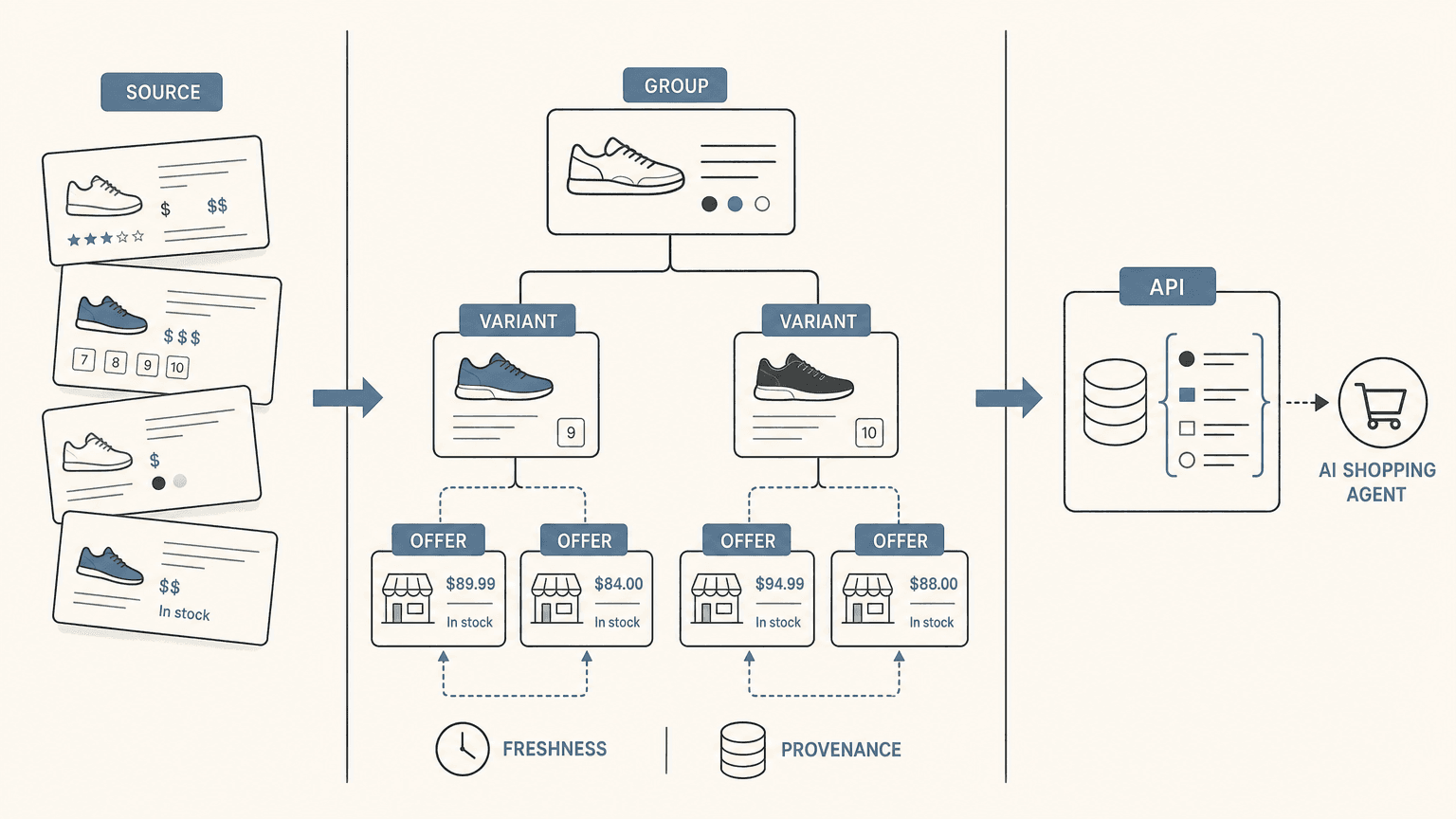
AI recommendations need more than a title and a price. A product group must stay linked to its variants. Each variant must retain its identifiers and option values. Each offer needs its seller, currency, availability, and observation time. Our product data API guide explains why these relationships matter when records move between systems.
How to evaluate a Salsify alternative
Use the same decision criteria for every vendor. Feature checklists hide the differences that matter after launch.
1. Define the source of truth
List every upstream source, including ERP, ecommerce platform, PLM, supplier feed, DAM, spreadsheet, and existing PIM. Decide which system owns each field. A tool that copies conflicting values into one interface has not created governance.
2. Test the data model at variant and offer level
Use real products with parent-child relationships, bundles, region-specific attributes, and multiple offers. Confirm that the system preserves SKU, GTIN, MPN, product group, variant, seller, currency, price, availability, and source timestamps. GS1's GTIN guidance is a useful reference for identifier ownership and reuse.
3. Map the destinations before the demo
Write down the exact destinations you need. These may include Amazon, Walmart, Shopify, regional retailers, distributor portals, Google Merchant Center, ChatGPT, Gemini, Claude, or Perplexity. Ask the vendor to show the output for one product on each destination. A connector list is not proof that the data model and field mapping fit your use case.
4. Measure freshness, review, and control
Change a test price and stock value. Record how long each destination takes to show the new value. Test an out-of-stock variant, a discontinued product, and a region-specific offer. Review how enrichment is approved, rolled back, attributed, and blocked by channel.
For AI commerce, ask how you can measure product coverage, recommendation rate, accuracy, citations, and downstream sessions. Our guide to AI visibility for ecommerce explains why brand mentions alone do not show whether the right products are being recommended.
5. Price the operating model, not just the license
Treat enterprise PIM, PXM, and syndication pricing as a custom quote until you have the full scope. Total cost can include catalog modeling, DAM migration, retailer mapping, connector setup, localization, implementation services, support, data refreshes, and new channel work.
Give every vendor the same scope: product count, variants, markets, users, destinations, refresh frequency, and implementation ownership. Include the cost of keeping a failed or partial integration running. Open-core options such as Pimcore may reduce license constraints while increasing engineering responsibility. A lower subscription does not always mean a lower operating cost.
Run a five-test pilot before committing
A two-hour demo cannot show how an alternative behaves when your catalog changes. Use a small but representative test set.
- Variant integrity: Load products with at least three variants, option values, identifiers, and separate offers. Verify parent and child links after import and export.
- Channel transformation: Publish one record to a retailer feed and one AI-facing output. Compare field names, units, media, policies, and fallback behavior.
- Freshness: Change price, stock, and a stable description at different times. Measure when each change appears downstream. Keep price and availability on a tighter service target than stable copy.
- Discovery: Run prompts that describe a use case, constraint, budget, material, fit, or compatibility requirement. Check whether the right products appear and whether the facts are accurate.
- Governance and exit: Approve, reject, correct, and roll back an enrichment. Export the records and audit history. Confirm what remains usable if the contract ends.
This pilot reveals whether you are buying a system of record, a publishing network, an AI product-data layer, or a combination. It also gives procurement a comparable result instead of a collection of feature claims.
FAQ
Is Salsify a PIM or a PXM?
Salsify is positioned as a PXM platform. It includes PIM capabilities and adds product experience workflows, digital assets, syndication, and digital shelf functions. Buyers often compare it with both PIM systems and broader product-content networks.
Which Salsify alternative fits AI commerce?
We are a direct fit when the job is to make products understandable and available across AI shopping surfaces. Catalog runs as a parallel layer, keeps your existing storefront in place, syncs live product facts, and gives you control over AI distribution. A traditional PIM remains the better starting point when internal catalog governance is the main problem.
Can Catalog replace Salsify?
We can replace Salsify when your primary requirement is AI product-data distribution and you do not need Salsify's deeper PXM, DAM, or retailer-network workflows. Many larger brands should use both: keep the PIM or PXM as the internal source and use Catalog as the AI-commerce layer.
What should I ask a Salsify competitor about AI readiness?
Ask for a live demonstration of variant-level data, price and availability refresh, machine-readable outputs, reviewable enrichment, channel controls, and product-level visibility reporting. The word “AI” in a feature name does not answer those questions.
If AI surfaces are the gap, request Catalog's free product-data audit. We will show what AI systems get wrong about your products and where a live product-data layer can close the gap.
