
Perpetual vs. periodic inventory systems: An ecommerce decision guide
Compare perpetual and periodic inventory systems for ecommerce, with accounting differences, channel impacts, reconciliation, and a decision checklist.
Inventory records can look current in one system while your storefront and marketplace make different promises. The choice between perpetual and periodic inventory affects how quickly a sale changes available-to-sell stock, how often your team reconciles, and whether channel updates keep pace. This guide puts the accounting distinction beside the operating reality: variants, locations, reservations, returns, and feed freshness.
Perpetual vs. periodic inventory systems at a glance
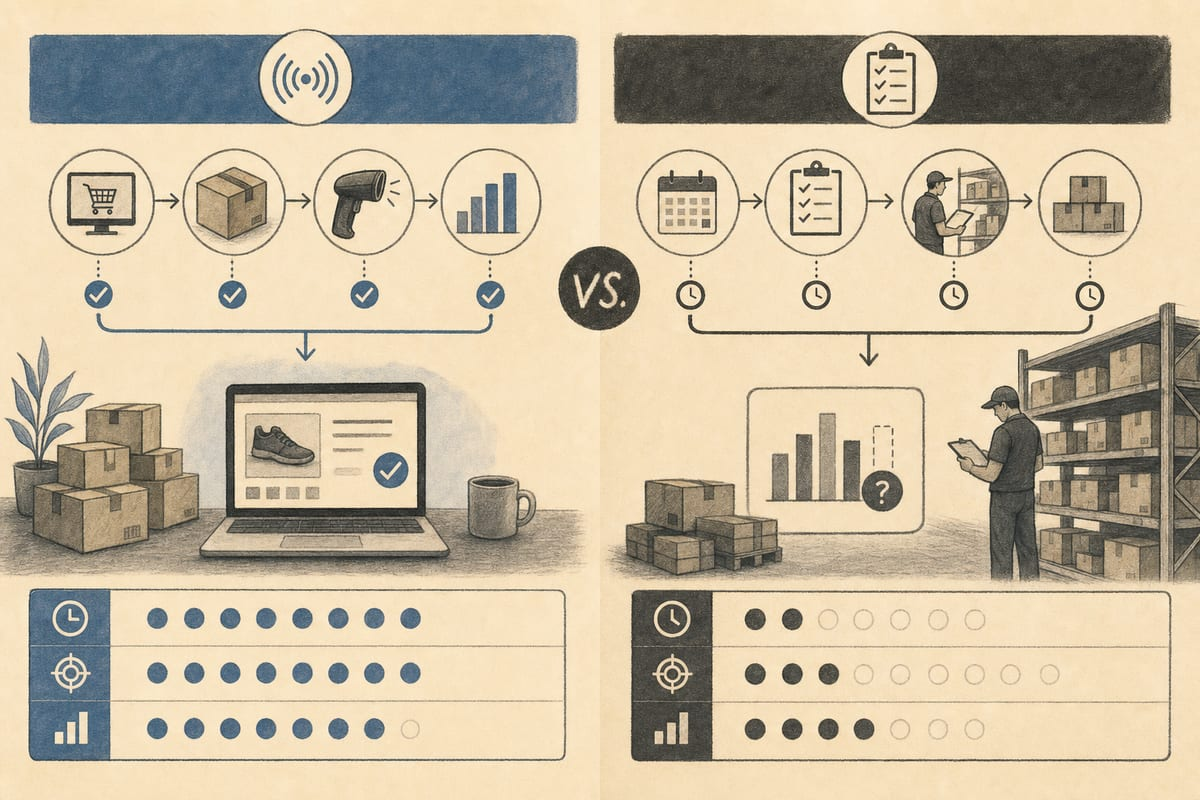
A perpetual inventory system updates the inventory record as each inventory-affecting event is captured. Receipts, sales, transfers, returns, and approved adjustments change the book balance continuously or close to it.
A periodic inventory system updates the inventory balance at scheduled intervals, usually after a physical count or period close. Purchases and sales can still be recorded in other systems during the period, but the inventory balance is not the authoritative measure of what is sellable until the next update.
For the broader inventory-management model, see our inventory management glossary. The comparison below focuses on the record-update method.
| Dimension | Perpetual system | Periodic system |
|---|---|---|
| Inventory record | Changes with captured receipts, sales, transfers, returns, and adjustments | Changes at a planned count or reconciliation |
| Availability between counts | A current book balance, if events and identifiers are reliable | A previous count or estimate, until the next count |
| Cost of goods sold (COGS) | Available as transactions post, subject to the chosen cost-flow rule | Calculated at period close from beginning inventory, purchases, and ending inventory |
| Main control | Event capture, integrations, exception handling, and physical checks | Count schedule, receiving and sales records, and period-end adjustments |
| Typical operating fit | Fast-moving SKUs, many variants, multiple locations, or shared channels | Small catalog, low velocity, one location, and low cost of stale availability |
| Setup and labor | More system setup, integration, training, and ongoing monitoring | Lower system setup, with more count labor and operational interruption |
| Main risk | A missed event or wrong SKU can make a fast update wrong | Shrinkage, overselling, and receiving errors can stay hidden between counts |
The important boundary is authority. A spreadsheet that is edited every night may be a scheduled process, while a warehouse system that posts a sale immediately is operating perpetually. The label follows when the inventory balance changes, not whether the team uses software.
Catalog sits downstream of this choice. We do not own warehouse counts or order transactions. We help normalize and expose product, variant, availability, and channel facts from the operational source so storefronts, feeds, marketplaces, search, and AI-shopping surfaces can use them. That handoff is useful only when the source cadence and product identities are clear.
What a perpetual inventory system records
Perpetual tracking turns inventory movement into a sequence of ledger events. A typical flow looks like this:
- A receipt adds accepted units to a specific SKU and location.
- An order reserves or commits units according to the merchant's allocation rule.
- A shipment, cancellation, return, transfer, damage report, or adjustment changes the relevant status and quantity.
- The source system recalculates on-hand, reserved, and available-to-sell quantities.
- The new availability is sent to the storefront, marketplace, feed, or other destination.
This gives an operator a usable answer between physical counts and a trail for investigating changes. It only works when systems use the same product and location identities and send complete events. A perpetual ledger can be wrong for weeks if a point-of-sale sale is missed, a return never moves out of quarantine, or a marketplace listing maps to the wrong variant.
Perpetual does not mean every destination updates at the same instant. The ledger may change when an order is captured while a marketplace receives the update in a batch. Record cadence and downstream synchronization are separate decisions.
What a periodic inventory system records
Periodic tracking treats the physical count as the point at which the inventory balance becomes known. Purchase orders, sales orders, and shipment records can support operations during the period, but they do not replace the scheduled measurement.
At the end of the period, the team counts stock, investigates differences, and updates the books. The familiar COGS calculation is:
Beginning inventory + net purchases - ending inventory = COGS
That approach can be practical when a count is quick and stale availability has little commercial impact. It becomes harder when the team has many variants, stock spread across locations, or a shared pool promised across several channels. A product can sell out on Tuesday and still look available to another channel until the next count or manual adjustment.
Periodic does not mean inaccurate by definition. A careful count can correct receiving errors, shrinkage, and damaged stock that a perpetual system missed. The trade-off is that the correction arrives at the count interval rather than when the event happens.
The accounting distinction: update cadence versus cost flow
Perpetual and periodic describe when the quantity and inventory accounts are updated. They do not describe how the cost of each unit is assigned. FIFO, weighted average, specific identification, and other cost-flow assumptions are separate choices. The same cost-flow approach can be implemented with either record-update method, with different timing and calculation mechanics.
In a typical perpetual ledger, a purchase increases inventory and a sale records COGS and reduces inventory as the transaction posts. In a periodic ledger, purchases are accumulated during the period and ending inventory is measured before COGS is finalized. The exact accounts, timing, returns treatment, and cost rules depend on the accounting setup.
For U.S. tax context, IRS Publication 538 describes perpetual or book inventory under sound accounting practices and says a physical inventory should be taken at reasonable intervals, with the book amount adjusted to actual inventory. That is a useful guardrail: transaction-level records still need physical controls. Tax and financial-reporting rules vary by jurisdiction, reporting basis, and business circumstances, so use your accountant for a method change or filing decision.
Example: one variant across a warehouse, store, and marketplace
Consider Northline Apparel's blue jacket, size medium, with SKU JKT-BLU-M. The parent product has other colors and sizes, but this child variant is the unit that must be received, sold, counted, and published. Northline has 10 units in warehouse WH-A and four in Store-1. Two warehouse units are reserved for direct-to-consumer orders, leaving 12 available to sell before safety-stock rules.
The day then produces five events:
- Marketplace order: one
JKT-BLU-Mis committed fromWH-A. A perpetual record reduces available-to-sell stock as soon as the order is captured or allocated, according to Northline's rule. The marketplace and storefront can receive the lower quantity. - Point-of-sale sale: one unit sells in
Store-1. The perpetual record updates the store location, while the shared availability view recalculates the total. A periodic record can retain the last counted balance until the next count. - Transfer: two units move from
WH-AtoStore-1. Perpetual tracking records the origin, destination, and in-transit status so the units are not promised twice. Periodic tracking needs a transfer log and a later count to make the location balances authoritative. - Return: a customer sends one jacket back. Perpetual tracking can place it in a returned or quarantine status and add it to sellable stock only after inspection. A periodic process may not reflect the returned unit until a person counts it and decides its condition.
- Damage adjustment: one jacket is damaged during handling. A perpetual adjustment removes it from sellable stock with a reason and audit trail. Under periodic tracking, the damage can remain invisible to channel availability until the count.
The example exposes the operational difference. Perpetual tracking gives each event a place in the SKU-and-location ledger. Periodic tracking gives the team a measured snapshot at the next count. Neither works if the marketplace uses BLUE-M, the POS uses JKT-BLU-M-STORE, and no mapping tells the source system that these are the same variant. Fast propagation of a mismatched identity only spreads the error faster.
Pros and cons for ecommerce operators
Perpetual system
Advantages
- Current operating signal. You can calculate available-to-sell stock from captured events instead of waiting for the next count.
- Better multi-location coordination. Transfers, reservations, and store or warehouse balances can share one event history.
- Faster decisions. Reorder triggers, allocation rules, and channel availability can react to sales and receipts sooner.
- Clearer investigation. An event trail helps isolate a missed receipt, unprocessed return, wrong location, or manual adjustment.
Trade-offs
- More implementation work. You need stable SKU and location identifiers, integrations, status rules, and staff training.
- Integration dependency. An outage or missing webhook can leave the book balance behind the physical stock.
- Garbage-in risk. A wrong variant, duplicate SKU, or unapproved receipt makes the ledger precise and wrong.
- Physical controls still matter. Counts and adjustments find shrinkage and events that software never captured.
Periodic system
Advantages
- Low initial complexity. A small team can start with a count sheet or simple system rather than integrating every movement.
- A clear close. A scheduled count can establish the inventory balance needed for a period-end report.
- Appropriate for low-risk stock. Slow-moving items in one location may not justify transaction-level infrastructure.
- Physical visibility. Counts expose damage, shrinkage, and receiving mistakes that an event ledger cannot infer.
Trade-offs
- Stale availability. Between counts, the team may not know which variant or location can fulfill an order.
- Count burden grows with scope. More SKUs, bins, stores, and channels make counts slower and more disruptive.
- Delayed exception response. Oversells, stockouts, and shrinkage may surface only after the period closes.
- Less timely COGS. In-period COGS and margin views may be estimates until ending inventory is measured.
When each system fits
Choose periodic tracking when most of these statements are true:
- You carry a small number of low-velocity SKUs.
- Stock sits in one location or is not shared across locations.
- Orders are infrequent enough that a count can keep up.
- Customers can tolerate a manual availability check or a conservative stock buffer.
- The cost of a stale promise is lower than the cost of event-level infrastructure.
Choose perpetual tracking when any of these conditions creates meaningful risk:
- A fast-selling or scarce variant can sell through between counts.
- Online, in-store, wholesale, or marketplace orders draw from the same stock.
- You promise ship-from-store, pickup, regional availability, or a tight delivery window.
- Replenishment, allocation, or margin decisions depend on current SKU-level quantities.
- Overselling, canceled orders, or a channel suspension costs more than the implementation effort.
Many operators use a risk-based combination. They maintain transaction-level records for high-velocity or high-value items and locations, run cycle counts across the wider catalog, and keep a periodic full count for physical control. Define the boundary clearly. A SKU should have one named source of truth for each location and status, even if different categories receive different control intensity.
Reconciliation and data freshness determine trust
The useful question is whether a customer-facing availability promise is based on a known, recent, reconciled record. Our inventory management process covers the wider operating loop. For this decision, focus on these controls.
Reconcile a perpetual record
- Set a baseline. Count by location and record opening on-hand, reserved, damaged, in-transit, and available-to-sell quantities.
- Capture every event. Include receipts, reservations, shipments, cancellations, returns, transfers, damage, shrinkage, and adjustments.
- Compare expected with counted. Investigate differences by event type, location, operator, and time window. Do not hide a variance inside an unexplained adjustment.
- Test identity and cycle-count risk. Confirm SKU, variant, barcode, bundle, and location mappings, then count fast movers, high-value items, high-variance locations, and repeated channel errors more often.
Reconcile a periodic record
- Set a cadence based on velocity, margin, shrink risk, and the cost of a wrong promise.
- Freeze or timestamp movement while counting so receipts, picks, transfers, and returns are not counted twice or missed.
- Compare the count with purchase, sales, transfer, and return records, and record the reason for each adjustment.
- Publish a conservative availability state between counts. Shorten the interval or move high-risk SKUs to transaction-level tracking when exceptions repeat.
Separate ledger freshness from channel freshness
Ecommerce inventory has at least three clocks:
- Event freshness: how long after a receipt, sale, return, or adjustment the source record changes.
- Propagation freshness: how long the new record takes to reach a storefront, marketplace, feed, search index, or shopping agent.
- Truth freshness: how recently the physical stock was checked against the record.
A perpetual ledger can have strong event freshness and weak propagation freshness if feeds run nightly. A periodic system can have strong truth freshness at the moment of a count and weak truth freshness afterward. Track the source timestamp and destination acceptance time. In Google Merchant Center's product data specification, availability must match the landing page, checkout, and structured data. Channel propagation is therefore part of inventory control.
This is also why perpetual inventory is not the same as real-time data synchronization. Data synchronization describes how changes move between systems. Perpetual inventory describes when the inventory record changes. A reliable setup needs both a complete event record and a delivery path that meets the channel's freshness tolerance.
A practical decision checklist
Answer these questions with numbers or named owners before choosing a method:
- What is the source of truth? Name the system that owns on-hand, reserved, and available-to-sell stock for every location.
- Which events change sellable stock? Write down the exact trigger for receipt, reservation, shipment, cancellation, return, transfer, damage, and adjustment.
- How many SKUs and variants move each day? Include bundles, kits, and channel-specific listings, not only parent products.
- How many locations and channels share units? Count warehouses, stores, third-party logistics providers, your storefront, marketplaces, and wholesale allocations.
- How stale can a promise be? Set a maximum age for availability by channel. A weekly count is different from a 15-minute ship-from-store promise.
- What is the cost of being wrong? Estimate margin loss, canceled orders, expedited shipping, marketplace penalties, support work, and lost trust from an oversell or stockout.
- Can systems capture events and catch drift? Check identifiers, webhook or file reliability, offline behavior, retries, duplicate handling, cycle-count rules, and adjustment ownership.
- What does finance need during the period? Decide whether current COGS and inventory balances are required for operating decisions or only at close, then confirm the treatment with your accountant.
If the answers show low velocity, one location, and a high tolerance for stale availability, periodic tracking may be enough. If they show shared stock, fast movement, or costly oversells, use perpetual tracking for those flows. If the answers differ by category, start with a controlled transition:
- Normalize SKU, variant, location, and channel identifiers.
- Take and approve a baseline count, then connect the highest-risk event sources first.
- Run old and new balances in parallel through one reconciliation cycle.
- Move priority SKUs and channels to transaction-level updates, then expand as exception rates and freshness metrics improve.
FAQ
Is a perpetual inventory system truly real time?
It is transaction-level tracking, not a promise that every destination updates instantly. A source ledger may update when an order is captured while a marketplace or feed receives the change later. Measure the end-to-end freshness that your customer sees.
Do perpetual systems eliminate physical inventory counts?
No. Physical counts find shrinkage, damage, mispicks, receiving errors, and missed events. Use cycle counts and periodic physical controls to adjust the book record to what is actually present.
Is a periodic inventory system inaccurate?
It can be accurate at the time of a well-controlled count. Its weakness is the interval between counts, when sales, returns, transfers, and damage can make the last measured balance stale.
Can perpetual and periodic systems use FIFO or weighted average cost?
Yes. Record-update cadence and cost-flow assumption are separate decisions. Your accountant should confirm which cost method and implementation meet the rules for your reporting and tax situation.
Can a small ecommerce business use periodic inventory?
Yes, if its catalog, velocity, location count, and customer promises allow the team to count often enough. Use conservative buffers and manual exception handling when the storefront or marketplace cannot receive a current quantity.
Does Catalog replace an inventory management system?
No. Catalog does not own warehouse counts, purchasing, order routing, POS transactions, or fulfillment. We help turn the product and availability records from those systems into normalized, machine-readable product data for storefronts, feeds, marketplaces, search, and AI-shopping surfaces. If you need to make those records consistent across destinations, explore Catalog.
