
Marketplace operations need a trusted product catalog
Learn marketplace operations for seller catalog intake, product matching, data governance, listing quality, and accurate product records across channels.

Marketplace operations span seller onboarding, product listings, price and inventory updates, and the service work behind every order. When you run a multi-seller marketplace or sell a catalog across channels, product data has to keep its identity as it moves between people and systems. A clear operating model follows each record from intake through matching, approval, publication, and correction.
What marketplace operations cover
Marketplace operations are the day-to-day processes that make a multi-vendor platform or channel program run: recruiting and onboarding sellers, organizing product catalogs, publishing and maintaining listings, syncing offers, routing orders, handling returns and service, and monitoring seller performance.
The work has two shapes. A retailer operating a marketplace receives product data from many sellers and decides which sellers may offer each item. A brand selling across Amazon, Walmart, a retailer network, and its own store maintains product facts and maps them into several destination schemas. The channel model differs, but the data work overlaps: teams need to know what an item is, who offers it, and what each destination expects. Our third-party marketplace guide explains the roles when a retailer hosts outside sellers.
Order routing, payments, fulfillment, and customer service are separate functions that depend on accurate item, seller, and offer data.
Keep product identity, seller offers, and listings separate
A useful catalog model separates three connected records, even if a marketplace platform displays them together.
| Record | What it describes | Typical fields |
|---|---|---|
| Product | The item and its variants, shared across sellers and channels | Brand, product identifier, model, variant or pack relationship, product attributes, images |
| Seller offer | One seller's commercial terms for that item | Seller ID and stock keeping unit (SKU), price, currency, available quantity, fulfillment, lead time, returns |
| Channel listing | The item's destination-specific presentation | Marketplace ID, category, required attributes, title and media, approval status |
Imagine three sellers offering the same 32-ounce insulated bottle. The marketplace can reuse one product identity while keeping three prices, inventory counts, and service terms. A 24-pack of the bottle may be a separate trade item with its own identifier. A brand sending the same item to several marketplaces may also need several listings because category, required attributes, and title rules vary by destination.
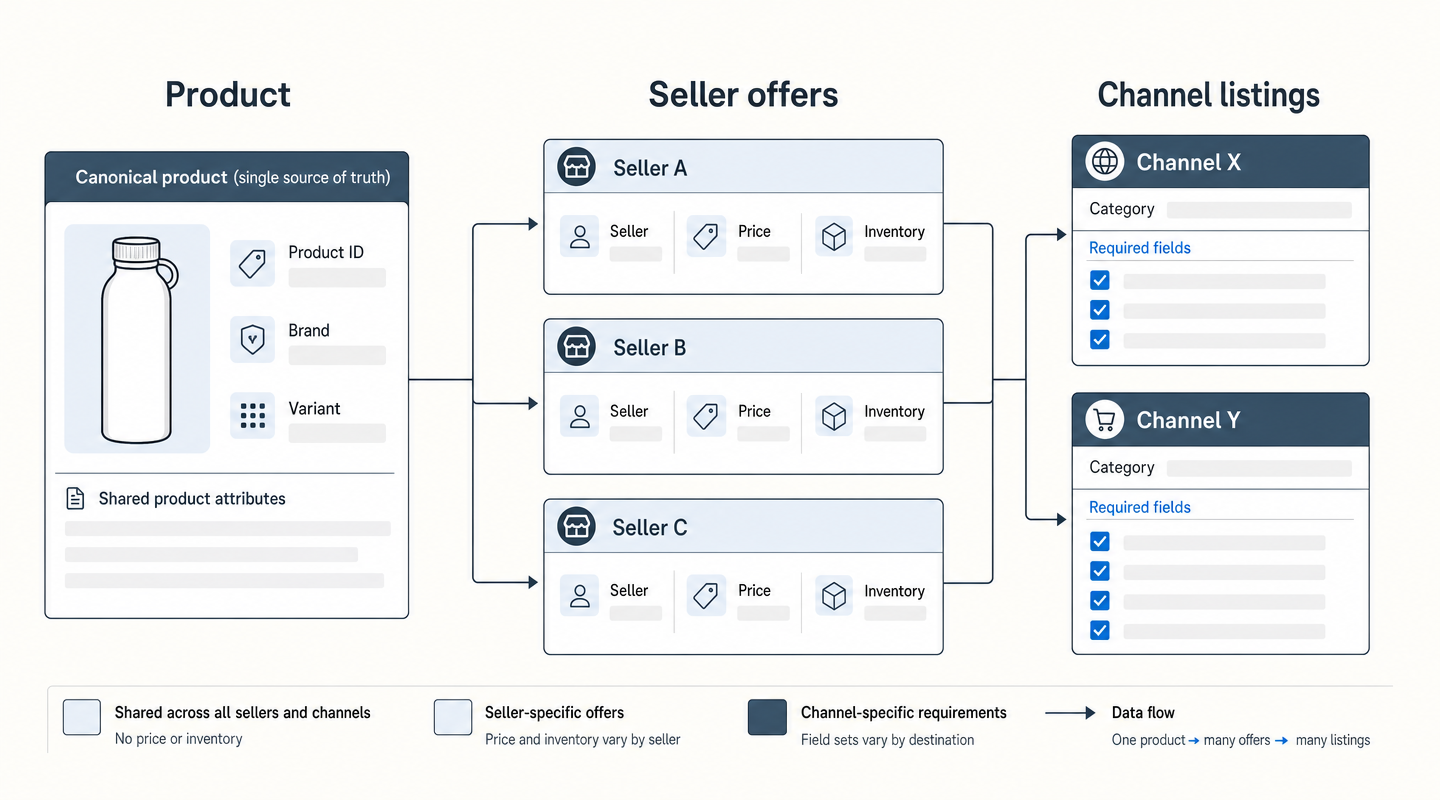
Amazon's product-ID listing workflow follows this separation: sellers search for a matching product and add offer details to an existing listing, or create a new listing when there is no match. Keep your own stable product and variant IDs, then store marketplace IDs and seller SKUs as separate references. One seller's SKU should never overwrite another seller's offer.
Set a data contract at seller intake
Seller onboarding works faster when catalog requirements are agreed before the first import. Give every seller a clear intake contract that defines:
- How product data can arrive, such as an application programming interface (API), a seller portal, or a structured file.
- The seller ID and seller SKU, plus product identifiers such as Global Trade Item Number (GTIN), Universal Product Code (UPC), European Article Number (EAN), or manufacturer part number (MPN) where available or required.
- Product fields such as brand, model, category, variant relationships, size, material, dimensions, and image URLs.
- Offer fields such as price, currency, available quantity, fulfillment method, lead time, and return terms.
- Required fields, accepted values, units, and validation rules for each product category.
- How often each field must update and what happens when a field is missing or conflicts with another source.
Store the submitted row before transforming it. Record the seller, source system, source timestamp, feed version, and row key alongside the normalized record. That provenance lets an operator trace a live listing back to the exact value received instead of guessing which upload introduced an error.
Return row-level errors with the field name, submitted value, reason, and expected format. A seller who sends an invalid GTIN or omits a required category field needs a precise correction request. A generic “upload failed” response leaves the seller guessing; a row-level error tells them what to correct before the next file.
Block records with unresolved identity or offer conflicts. Route uncertain product claims and policy-sensitive fields for review. Optional content can move to an enrichment queue, but an unknown value should stay unknown until a reliable source supplies it.
Normalize seller data before mapping it to channels
Different sellers describe the same attribute in different ways. Create a shared product model with a definition for each field: data type, unit, allowed values, owner, and source precedence. Normalize values while preserving what the seller sent and where it came from.
For example, store dimensions in a consistent unit and keep the submitted value for audit. Map a seller's category to the marketplace's category through a maintained translation table. Standardize color names only when the values mean the same thing. Keep source categories and channel-specific mappings in separate fields so a change for one destination does not alter another.
Category rules need to be specific. A product type may require an attribute that a general catalog does not collect. Walmart's item setup spec exposes requirements by product type, including required attributes, allowed values, formatting rules, and conditional requirements. Use the current destination specification when you build or update a mapping.
Normalization should not fill gaps with guesses. If a material or compatibility field is unknown, keep it empty and send the record to the right owner. A confident but incorrect value can create the same customer and channel problems as a missing value. For the broader channel-feed workflow, see our product feed management guide.
Match incoming products without creating duplicates
Product matching decides whether a seller's row describes an item already in the marketplace catalog or a new product. Use several signals and make uncertain matches visible.
- Validate identifiers. Normalize GTIN, UPC, EAN, and MPN values, then compare them with brand and model data.
- Confirm the exact variant and package. Check size, color, model, item count, unit of measure, and pack configuration.
- Use titles and images to find likely candidates; require identifier and variant evidence before merging.
- Link high-confidence matches to the canonical product and create a separate seller offer. Send conflicting candidates for review. Create a new product record when no existing item fits.
Calibrate any automatic-match threshold with a manually reviewed set of known matches and non-matches. Track false merges separately from missed matches. A single aggregate error rate can hide identity mistakes.
A GTIN identifies a specific trade item. It does not identify the broader product family. GS1's GTIN standard assigns separate identifiers to distinct trade items and pack groupings. Walmart's product-ID guidance warns that an incorrect product ID can merge a 12-pack with a 24-pack and cause buyers to receive a different quantity than the listing describes. Treat a mismatch in size, color, model, or pack count as a data exception, even when the title looks similar.
Set an exception queue for missing identifiers, duplicate candidates, reused IDs, and conflicting variant data. Record why each match was accepted, rejected, or escalated. Review the queue by seller and category so repeat problems lead to better intake rules rather than one-off fixes.
Assign owners and rules to each field
A data-quality process needs an accountable owner for each class of information. One team can coordinate the catalog, but the source of a field should remain clear.
| Field group | Accountable owner | Operating rule |
|---|---|---|
| Product identity and specifications | Brand or product-data steward | Use an authoritative source, preserve provenance, and confirm variant or pack identity |
| Seller offer | Seller or commerce operations | Keep price, currency, stock, fulfillment, and returns seller-specific and current |
| Channel presentation | Marketplace or merchandising operations | Maintain destination mappings, required content, approval rules, and mapping versions |
Define which source wins when systems disagree. If price is sent by a seller's inventory feed and also entered in a portal, choose the authoritative source and the conflict action. Use three outcomes: publish, warn, or hold. Publish a record when identity is clear and required fields pass. Warn when optional detail is missing. Hold conflicting identifiers, questionable claims, or offers that have exceeded their freshness limit.
Every manual correction needs an owner, reason, timestamp, and path back to the source. A channel-only patch may make one page look right while the next sync restores the bad value. Use overrides sparingly and return lasting fixes to the system that owns the field. Our product data quality guide covers the broader dimensions behind these checks.
Validate listings before and after publication
Pre-publication checks should answer four questions:
- Does the identifier resolve to the right product, variant, and pack?
- Are the destination's required fields present and valid for the selected category?
- Do the images, titles, and claims describe the actual product the seller will ship?
- Do price, currency, availability, and fulfillment details match the offer source?
After submission, check the marketplace status and inspect the live listing. Confirm that product identity, variants, images, price, and availability match the approved source record. Capture rejection and suppression reasons as structured data, then route each one to the field owner who can fix it.
Google's product data specification warns that inaccurate or missing information can cause disapprovals, limited eligibility, or incorrect displays. It calls out wrong category or GTIN values, missing variant attributes, low-quality images, and conflicts between a data source and a product page. Across marketplaces, a successful file upload does not prove the right product is live with the right offer.
Measure accuracy, freshness, and time to live
Sales and order volume show business outcomes. Operational measures show where bad data enters the workflow and how much rework it creates.
| Measure | What to track | What it reveals |
|---|---|---|
| First-pass completeness | Share of seller records that pass required-field checks on arrival | Whether intake rules and seller guidance are clear |
| Match exception rate | Share of records sent to manual review or left unmatched | Identifier coverage and catalog ambiguity |
| First-pass listing acceptance | Share of submitted listings accepted without correction | Mapping quality and fit with channel requirements |
| Offer freshness | Share of price and availability updates inside the agreed update window | Reliability of seller and system synchronization |
| Time to live | Median time from complete seller submission to an active listing | Where onboarding, review, or publishing gets stuck |
Slice each measure by seller, category, and channel. A healthy average can hide one supplier whose data repeatedly creates duplicates or one product type with incomplete attributes. Use recurring errors to improve intake contracts, matching rules, and seller training.
Run a steady operating cadence
Marketplace operations are easier to control when teams review product data before a launch becomes urgent.
- Daily, reconcile fast-changing price and availability fields and triage rejected or suppressed listings.
- Weekly, review unmatched records, duplicate candidates, recurring error reasons, and sellers with repeated freshness breaches.
- Before adding a marketplace or category, refresh its taxonomy and field requirements, test representative products and variants, and approve the mapping.
- Monthly, audit field ownership, source precedence, and manual overrides to confirm that lasting fixes have reached the right system.
A new channel creates a new data contract. Treating it as a one-time upload leaves the team to maintain exceptions by hand.
Where Catalog fits
Catalog is the product data layer for making product information structured, current, and machine-readable. We turn raw product data into normalized records, keep them updated as catalogs change, publish product data to artificial intelligence (AI) shopping surfaces, and help brands measure product visibility and discovery outcomes. Marketplace platforms and commerce systems still own seller accounts, order routing, offers, and channel approval rules; Catalog works alongside those systems.
The same trusted product facts can support marketplace operations and the AI surfaces where shoppers are beginning to discover products. Our AI visibility guide explains how to measure brand and product coverage, recommendation rate, citation coverage, and accuracy. To make your product facts machine-readable for AI shopping, see Catalog's product data layer.
