
Product data lineage: a practical ecommerce guide
Trace a product attribute from source through enrichment, approval, channel mapping, and listing validation with a practical ecommerce lineage model.
A product listing can be accepted and still carry the wrong material, size, or compatibility detail. Once that value spreads to a storefront, marketplace, feed, and AI shopping surface, the original mistake becomes hard to find.
Product data lineage gives ecommerce teams a field-level answer to five questions: where a value came from, what changed it, who approved it, where it was sent, and whether each destination accepted it. The workflow follows one attribute from supplier source to published listing, then turns the example into a practical audit model.
What product data lineage means
Product data lineage is the traceable path of a product record or attribute from its source through every meaningful transformation to each downstream listing or consumer.
For a product field, lineage records more than the current value. It connects versions of the value to the activities and systems that produced them. A useful lineage view can show:
- the supplier file, manufacturer page, PIM, ERP, or other source record;
- the raw value and the time it was collected;
- extraction, enrichment, normalization, or conflict-resolution steps;
- the person, rule, model, or job that changed the value;
- the approval decision and its evidence;
- each channel mapping and transformed output;
- listing validation results, warnings, rejections, and publish times.
That makes lineage operational. If a marketplace shows the wrong volume, you can trace the destination value backward to the mapping rule and then to the approved product attribute. If a supplier corrects a specification, you can trace the value forward to every channel that needs a resync.
The scope is smaller and more useful than a generic data-governance program. Start with the attributes that affect discovery, comparison, safety, claims, price, availability, and channel acceptance. Our product data quality guide covers the checks that determine whether those fields are complete, consistent, and usable.
Follow one product attribute from source to listing
Consider a reusable bottle with SKU SUMMIT-750-BLK. The supplier's specification PDF says Capacity: 0.75 L. The merchant's canonical catalog stores capacity as a numeric value in milliliters. Google Merchant Center and the storefront each need a channel-ready representation.
A diagram-friendly view of the path looks like this:
Supplier PDF
  capacity = "0.75 L"
       │
       ▼
Ingestion record
  source_id = supplier_1842/spec-2026-04
       │  OCR + field extraction
       ▼
Enriched attribute
  capacity_raw = "0.75 L"
  evidence = page 2, capacity table
       │  unit conversion rule v3
       ▼
Normalized canonical field
  capacity.value = 750
  capacity.unit = "mL"
       │  merchandiser approval
       ▼
Approved product record
  status = approved
       │
       ├── Storefront mapping: category metafield "Capacity" = 750 mL
       ├── Google mapping: product detail "capacity" = 750 mL
       └── AI product object: capacity = {value: 750, unit: "mL"}
                         │
                         ▼
                 Listing validation
          accepted, rendered, synced at 2026-04-18T14:10Z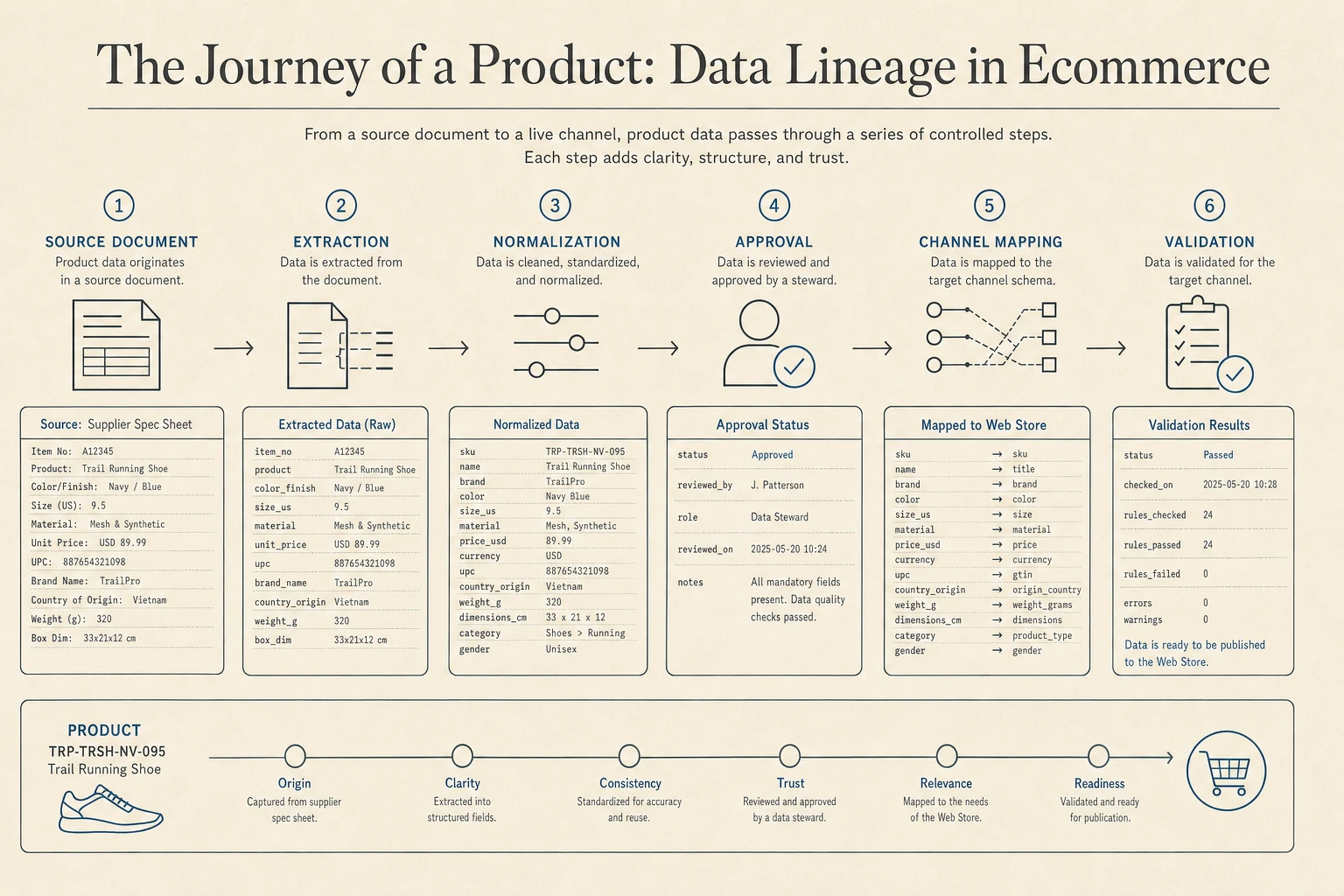
The arrows are the lineage. The values and metadata beside each node are the evidence needed to explain the arrows.
1. Capture the source value
The ingestion event should preserve the original string, source record, file version, and retrieval time. Keep the source pointer specific enough for another person to find the evidence. A URL alone may be insufficient when a supplier replaces a PDF. Store a file version, page or cell reference, or content hash where the source system allows it.
The source value is 0.75 L, not 750 mL. That distinction matters. If the supplier later changes the specification to 0.70 L, the old value remains part of the history instead of disappearing behind an overwrite.
If the first step is turning documents into fields, use the workflow in product data extraction as the extraction layer. Extraction answers, “What does the source say?” Lineage continues by recording what happens after that answer is captured.
2. Enrich the attribute with evidence
Enrichment adds context that the raw source does not provide in a channel-ready shape. In this example, the enrichment record can attach the source page, identify the field as a capacity measurement, and flag the unit for normalization.
Enrichment should preserve the raw value alongside the proposed value. Do not replace 0.75 L with 750 mL before recording how the conversion happened. If a model or rule infers an attribute, record the inference method and evidence. A model can propose a value. A human or explicit policy still needs to decide whether that value is allowed to publish.
We treat product data enrichment as a way to create machine-readable product records, not as a copywriting step. The same discipline helps lineage: every enriched field needs a reason, an input, and a versioned operation.
3. Normalize into a canonical value
Normalization turns equivalent source values into one controlled representation. The rule liters × 1,000 = milliliters converts 0.75 L to 750 mL. The canonical record stores the number and unit separately, so systems can compare it without parsing a sentence.
Record the rule ID and version. A later team may change the canonical unit to liters, or fix a rounding rule. Versioned transformation metadata lets you recalculate affected records and identify which listings used the old rule.
Normalization can cover more than units:
navy,dark blue, andmidnightcan be mapped to a controlled color vocabulary after review;stainless steel 304can be separated into material and grade fields;12 x 8 x 4 incan become typed length, width, and height values;- supplier categories can be mapped to a canonical taxonomy path;
- variant rows can be connected to a parent product without changing their identifiers.
A normalized value is still a candidate until the required owner approves it.
4. Approve the value and its evidence
Approval is a business decision recorded in the lineage, not a side comment in a spreadsheet. A merchandiser reviews the source reference, the conversion rule, and any conflicting values. They approve 750 mL for the bottle's canonical record at a specific time.
Store the approver, approval state, timestamp, and policy or workflow version. If the source later conflicts with another supplier, the record should show whether the team accepted the supplier value, rejected it, or held publication pending review.
Approval does not mean every channel uses the same text. It means downstream transformations start from a known, governed value. A channel can format 750 mL as 0.75 L without changing the canonical record, provided the mapping is explicit and validated.
5. Map the field to each channel
Mapping translates a canonical field into a destination schema. It is one step in the lineage, not the lineage itself.
For the bottle, the mapping might be:
| Destination | Source field | Output | Mapping record |
|---|---|---|---|
| Storefront | capacity.value + capacity.unit | Category metafield Capacity = 750 mL | shopify-category-v4 |
| Google Merchant Center | capacity.value + capacity.unit | Product detail capacity: 750 mL | google-product-detail-v2 |
| AI product object | capacity | { "value": 750, "unit": "mL" } | catalog-object-v1 |
The channel's schema and vocabulary determine the output. Shopify's category metafields connect category-specific product attributes to storefront discovery, filters, and variant options. They are a platform feature, not a universal product-data standard.
Google Merchant Center provides a recognizable example of channel-specific lineage. A supplemental data source can add or update attributes on products from a primary source, and attribute rules can set, extract, concatenate, or otherwise modify inbound values. Google's data-source documentation and attribute-rule documentation describe those mechanics. Record which source and rule produced the output so a later reviewer can distinguish an approved canonical value from a channel override.
6. Validate the published listing
Validation closes the path. It should check both technical acceptance and the value a shopper or machine can actually see.
For the bottle, validation can confirm:
- the output contains a numeric capacity and an allowed unit;
- the channel accepted the record without a missing-field error;
- the value rendered on the listing or feed preview as
750 mL; - the variant and SKU still point to the same approved product;
- a resync reached the destination after the source change;
- any channel warning or rejection is attached to the relevant output record.
A green feed status does not prove that the source claim is true. It proves that the destination accepted the payload against its current checks. Keep source evidence and channel validation as separate events in the lineage.
For a broader view of preparing, mapping, publishing, and resynchronizing channel records, see product data syndication.
Lineage, provenance, mapping, and physical traceability
These terms overlap in conversation. They answer different questions in an ecommerce system.
| Concept | Main question | Product-data example | Boundary |
|---|---|---|---|
| Lineage | What path did the value take, what changed it, and where did it go? | 0.75 L was extracted from a supplier PDF, converted to 750 mL, approved, mapped to three outputs, and validated. | The complete path, including transformations and downstream impact. |
| Provenance | What is the origin and supporting evidence for this value? | Supplier PDF version, page reference, retrieval time, source owner, and confidence. | One layer of lineage focused on origin, custody, context, and trust. |
| Mapping | How does one field or value translate to a destination schema? | Canonical capacity becomes a Google product detail or a Shopify category metafield. | A transformation or relationship inside the path, not the history around it. |
| Physical-product traceability | Which item, lot, or shipment moved through which real-world events? | A serialized bottle lot was manufactured, packed, shipped, received, and recalled. | Follows physical objects and supply-chain events. It can link to product data, but it does not explain how a digital attribute was normalized or approved. |
ISO 8000-120 is a useful reference for representing and exchanging provenance for master-data characteristic values. Its scope does not define a complete characteristic-data model or exchange format, and it excludes change control. Treat it as provenance guidance rather than an end-to-end product-lineage mandate.
The W3C PROV-O model provides general concepts for entities, activities, and agents, along with relationships such as use, generation, derivation, responsibility, and time. It can inform an interoperable provenance model, yet it does not prescribe an ecommerce catalog schema.
OpenLineage's object model describes jobs, runs, datasets, and inputs or outputs for runtime and design-time pipeline lineage. That model is useful when product workflows run through data jobs. OpenLineage is not a product-catalog standard, and adopting it does not decide which product fields require approval or evidence.
Physical traceability uses another set of objects. GS1 describes EPCIS as a standard for sharing event data about what, when, where, why, and how an object moved or changed in a supply chain. GDSN addresses publication, subscription, and synchronization of item and location data between trading partners. Both can connect to a product data layer. Neither turns a channel listing's transformation history into physical chain-of-custody evidence.
Audit-log fields worth capturing
The right log is detailed enough to reconstruct a decision without forcing an operator to replay every pipeline. Treat the following as recommendations for a product-data workflow, not requirements imposed by a standard.
| Field group | Recommended fields | Why it helps |
|---|---|---|
| Record identity | lineage_event_id, product ID, SKU, variant ID, attribute path, parent event ID | Connects one field change to the correct product and prior event. |
| Source | Source system, source record ID, URI or file ID, version or hash, location such as page or cell, retrieved time | Preserves the exact evidence behind the value. |
| Values | Raw value, prior canonical value, new canonical value, data type, unit, locale | Shows what changed and prevents unit or formatting changes from hiding as overwrites. |
| Activity | Activity type, rule ID and version, job or run ID, input schema, output schema | Explains the transformation and makes it repeatable. |
| Actor | Human reviewer, service, model, or integration ID, role, execution time | Separates automated work from accountable decisions. |
| Evidence and confidence | Evidence pointer, confidence or quality score, conflict flag, policy reference | Tells reviewers why a value was accepted and where uncertainty remains. |
| Approval | Approval state, approver ID, approval timestamp, workflow version, rejection reason | Makes publication authority visible. |
| Destination | Channel, destination record ID, mapping ID and version, locale or market | Connects the approved field to every output that consumes it. |
| Validation | Check-set version, status, errors, warnings, preview or response ID, publish and sync times | Shows whether the destination accepted and displayed the value. |
| Change control | Superseded event, invalidated time, rollback reference, retention class | Preserves history when a correction replaces an earlier value. |
For most teams, field-level lineage for every attribute is unnecessary on day one. Start with high-impact fields and events that change their downstream meaning. Then add reverse lookup: from a source attribute to all affected listings, and from a rejected listing back to the source and transformation that caused it.
What lineage can and cannot prove
Lineage can prove that a value moved through a documented path. It can show that a rule ran, an approver accepted a value, a mapping produced an output, and a channel returned a validation result.
Lineage cannot prove that a supplier's claim is physically true, that a certification is valid, or that a product meets a law or safety requirement. Those questions need source evidence, testing, certifications, contractual controls, and the applicable legal or regulatory process. A complete log makes those evidence gaps visible. It does not fill them.
The same boundary applies to standards. A team can use ISO 8000-120, W3C PROV-O, OpenLineage, GS1, or a channel's own schema as design input. None of those references automatically certifies a Catalog workflow or makes a merchant compliant. Requirements vary by product category, market, channel, and regulated claim.
Where Catalog fits
We help brands structure product information into live, normalized product data that downstream systems and AI shopping surfaces can read. That makes it a natural layer for the middle of this lineage: extracting product facts, enriching missing attributes, preserving source context, normalizing values, and publishing typed product objects without replacing a merchant's system of record.
We also give teams a way to think in downstream impact. A change to one approved product attribute should lead to the affected storefront, feed, marketplace, API, or AI-facing output, rather than a new round of manual spreadsheet edits. Our complete guide to ecommerce product data explains how a product data layer fits alongside storefronts, PIMs, feeds, and APIs.
If you need product data that stays understandable from source through channel output, talk to Catalog. We can help you make the path visible and keep the published product object current.
Frequently asked questions
Is data lineage the same as an audit trail?
No. An audit trail records events for accountability, such as who approved a field and when. Lineage connects those events into the field's upstream and downstream path, including transformations and outputs. A lineage system can use audit-log events, yet a timestamped activity list without relationships is not enough to answer which listings a changed attribute affects.
Do I need a PIM to create product data lineage?
No. You need a stable product identity, a source of truth for approved values, and records of the transformations and destinations that touch them. A PIM can provide part of that workflow. An ERP, ecommerce platform, product data layer, or custom catalog can provide another part. The design should follow the field's path instead of assuming a specific system is the lineage system.
Does a channel validation result prove the product attribute is correct?
No. Channel validation usually checks payload structure, required fields, accepted values, and other destination rules. It does not independently verify a supplier's specification or a product claim. Keep source evidence, approval, and destination validation as separate linked events.
