
Semantic search for ecommerce product discovery
Learn how semantic search works for ecommerce, when to use keyword, vector, or hybrid retrieval, and how to implement it with reliable product data.
Shoppers describe what they need in their own language. Product catalogs describe what a brand sells in fields, titles, and specifications. Semantic search closes that gap by retrieving products according to meaning and intent.
For an ecommerce team, the search model is only one part of the system. The quality of the product data it receives determines whether a semantic match is useful or misleading. This guide explains how semantic search works, where it fits alongside keyword and vector search, and how to implement it without losing exact matches, hard constraints, or control over the result set.
What is semantic search?
Semantic search is an information-retrieval approach that interprets the meaning and intent of a query, then finds content or products that satisfy that meaning. It can connect different words that describe the same idea, understand a natural-language request, and use relationships between entities and attributes.
Consider a shopper searching for “a jacket for rainy bike rides.” A keyword engine may return products containing “jacket,” “rain,” or “bike.” A semantic system can connect the request to a water-resistant commuter shell even when the query's exact words do not appear in the product data. It should also recognize that water resistance is a selection attribute, that “bike rides” describes a use case, and that size and availability still determine whether the item can be bought.
Semantic search is a goal. Embeddings, vector indexes, natural-language processing, taxonomies, and knowledge graphs are techniques that can help achieve it. The implementation varies by search stack. The outcome should stay the same: a result set that answers the shopper's request with less query reformulation.
Semantic retrieval works best when a search system has complete, typed product facts to work with. We help brands create that foundation at Catalog by structuring product information into live, normalized product data that search systems and AI shopping surfaces can use consistently.
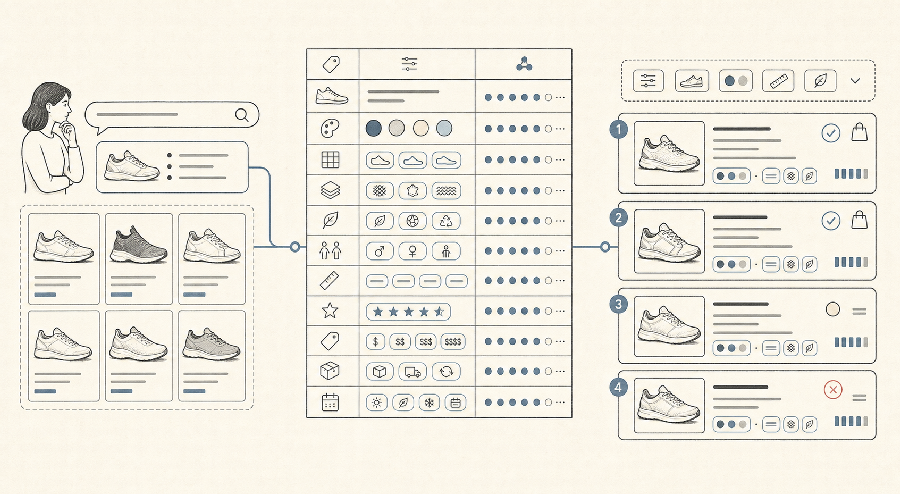
How semantic search works
A production semantic search system combines several stages. Every implementation has its own architecture, so treat this as a working model rather than a fixed algorithm.
1. Prepare the searchable product record
The system ingests product titles, descriptions, categories, attributes, variants, compatibility information, and other fields. It may also ingest reviews, buying guides, images, and query or purchase events. Keep product identity separate from descriptive language: SKU, GTIN, model number, size, price, and stock need typed fields, while use cases and styles can live in text and normalized attributes. Combining everything into one paragraph makes hard constraints harder to enforce.
2. Represent meaning
An embedding model turns text, images, or structured fields into numerical representations. Items with related meanings tend to be closer together in the model's vector space. A product representation might combine its title, category, use cases, and selected attributes. The query gets its own representation.
Sentence-BERT is an early, widely used example of this pattern. In the authors' 2019 paper, sentence embeddings could be compared with cosine similarity, reducing a 10,000-sentence similarity search from an estimated 65 hours of pairwise inference to about five seconds while retaining the evaluated accuracy. Read the Sentence-BERT research for the method and its limits.
Embeddings capture relationships in language. They do not verify stock, compatibility, or budget. Those facts need structured fields and current data.
3. Interpret the query
Query understanding identifies concepts and constraints. For “black waterproof hiking shoes under $140, size 10,” a parser might identify:
- category: hiking shoes;
- attribute: black;
- performance requirement: waterproof;
- price ceiling: $140;
- variant constraint: size 10.
The semantic portion retrieves related language. The structured portion filters out products that fail the price, size, color, or availability requirements.
4. Retrieve candidates
The engine retrieves a larger candidate set using one or more paths:
- lexical matching over titles, brands, SKUs, and attributes;
- vector similarity over embeddings;
- category, compatibility, price, geography, and availability filters;
- entity or taxonomy relationships.
Candidate retrieval is about recall. The system needs to bring plausible products into the set before ranking can choose the best ones.
5. Rank, filter, and explain
The final stage orders candidates by relevance and applies business rules such as availability, variant coverage, popularity, margin, freshness, delivery promise, or personalization. A relevance floor comes first. A product that cannot satisfy the query should not rise simply because it sells well.
The result should expose enough product information for the shopper to understand the match. Showing the relevant attribute, variant, price, and availability also gives the team a way to debug why a product appeared.
Semantic vs. keyword, vector, and hybrid search
These terms describe different layers of a search system. Treating them as interchangeable creates bad implementation decisions.
| Approach | What it does | Where it helps in ecommerce | Main limitation |
|---|---|---|---|
| Keyword or lexical search | Matches terms and their lexical variations in indexed fields | Exact SKUs, model numbers, brands, product names, and short category queries | Misses paraphrases and needs synonyms or query rules for different shopper language |
| Semantic search | Retrieves according to meaning, intent, and relationships | Natural-language needs, use cases, long-tail queries, and zero-result recovery | Can return a plausible-sounding product that fails a precise constraint |
| Vector search | Uses embeddings and nearest-neighbor similarity to implement semantic retrieval | Fast similarity retrieval across large catalogs and multimodal signals | A technique rather than a complete relevance strategy; similarity alone does not enforce product rules |
| Hybrid search | Combines lexical, semantic, and structured retrieval before ranking | Stores where exact identifiers and open-ended discovery happen together | Requires score fusion, tuning, monitoring, and clear precedence between signals |
Vector search is often part of semantic search. It is not the definition of semantic search. A semantic system can also use a taxonomy, synonyms, entity relationships, or a knowledge graph. A vector system can return nearby text while missing an important business constraint.
For most product catalogs, hybrid retrieval is the practical default. Preserve an exact match for “filter X100” or “model AC-2400.” Use semantic similarity for “replacement part for my compact air purifier.” Apply compatibility and availability filters to both paths, then fuse and rerank the eligible candidates.
Semantic search examples for ecommerce
Semantic search becomes easier to design when each query is connected to the product facts it needs.
| Shopper query | Product facts the system needs | Expected behavior |
|---|---|---|
| “Jacket for rainy bike rides” | Product type, water resistance, use case, weather protection, fit, sizes, stock | Retrieve commuter shells and rain jackets even when “bike” is absent from the title. Keep available sizes visible. |
| “Desk for a 10-foot room” | Dimensions, product type, room or use case, price, delivery region | Use semantic intent to find desks, then enforce a numeric width or depth limit. Vector similarity alone cannot guarantee the fit. |
| “Replacement filter for X100” | Model number, compatible devices, part number, product family, stock | Protect the exact model and compatibility match with lexical and structured retrieval. Do not let a similar-looking filter outrank it. |
| “Gift for a new homeowner under $50” | Use cases, product category, price, availability, giftability signals | Expand an open-ended request into relevant categories, then apply the price ceiling and inventory rules. |
| “Red pumps for a holiday party” | Color family, shoe type, occasion, style, size, stock | Connect occasion language to products with appropriate style and color attributes, even if “holiday” is not in the copy. |
This is where semantic search and ecommerce filters work together. Semantic retrieval helps interpret an open request. Facets and filters let the shopper confirm or tighten the result with attributes such as size, material, price, compatibility, or availability.
Search merchandising adds another layer. A search merchandising rule can boost an in-stock product or bury an unavailable variant after relevance has been established. It should not turn an unrelated campaign product into the answer to a specific need.
Product-data requirements for semantic search
Models cannot recover product facts that are absent, contradictory, or stale. Start with a data contract before choosing an embedding model.
Stable identity and relationships
Keep product, parent, and variant identifiers stable. Include SKU, GTIN, MPN, brand, canonical URL, and relationships between a parent product and its size, color, pack, or bundle variants. Compatibility should connect a replacement part to the devices it fits.
Taxonomy and typed attributes
Use a category path and category-specific fields. Store 10 in as a numeric dimension with a unit, not only as text in a description. Normalize color families, materials, sizes, fit, capacity, voltage, ingredients, and other selection attributes. A product data quality program measures completeness, consistency, validity, and freshness by category.
Query language and use cases
Capture shopper language, approved synonyms, and use cases. “Commuter shell,” “rain jacket,” and “waterproof cycling jacket” may overlap, while “water-resistant” and “waterproof” may carry different performance promises. Review synonyms with merchandising and product teams so they do not erase meaningful distinctions.
Commercial and operational facts
Pass current price, currency, inventory, regional availability, delivery promise, return restrictions, and variant-level stock as fields for filters and ranking. Refresh frequently changing values separately from slower-changing embeddings.
Content, media, and provenance
Descriptions and images add context. Image-derived signals can help with color or visual style, but they need validation. Record the source, update time, confidence, and transformation for enriched attributes so a merchandiser can resolve a questionable match.
Structured product data also supports discovery beyond an onsite search box. Google's Product structured data guide describes fields such as price, availability, shipping, returns, ratings, and product variants that can make product facts machine-readable for search experiences.
Catalog's role is the product data layer: we turn source information into live, normalized, typed product objects that downstream search systems, feeds, and AI shopping surfaces can reuse. The search index remains the system that retrieves and ranks those objects.
Benefits and trade-offs
Semantic search earns its place when it solves a measurable discovery problem. It also introduces new failure modes.
| Benefit | Trade-off to manage |
|---|---|
| Understands paraphrases and natural-language needs | Meaning-based similarity can blur distinctions such as waterproof vs. water-resistant |
| Recovers long-tail and zero-result queries | A broad fallback can hide genuine catalog gaps |
| Helps shoppers discover products by use case or problem | The system may need explanations so merchants can review why a result matched |
| Works across synonyms and, with the right model, multiple languages or media | Model quality varies by category, language, and product vocabulary |
| Reduces manual synonym rules over time | Embedding generation, storage, and reranking add cost and latency |
| Supports recommendations and AI-agent retrieval from the same product context | Stale embeddings can keep retired names, prices, or attributes in the candidate set |
Use lexical protection and hard filters for exact identifiers and constraints. Keep an audit trail for enrichment and ranking decisions. Refresh embeddings when meaningful descriptive fields change, and update price and availability on their own operational schedule.
How to evaluate semantic search
Do not judge semantic search from a handful of impressive queries. Build an evaluation set from real traffic and failure cases.
Create a query test set
Include representative examples from each intent class:
- exact product, brand, SKU, and model queries;
- category and attribute combinations;
- natural-language use-case queries;
- compatibility and replacement-part queries;
- misspellings, synonyms, and multilingual variants;
- price, size, color, and availability constraints;
- historical zero-result, no-click, and high-refinement queries.
For each query, label acceptable products, unacceptable products, and required constraints. Include variant-level judgments for parent products with several sizes or colors.
Measure retrieval and ranking separately
Track recall@k to see whether eligible products enter the candidate set. Track precision@k or nDCG@k to see whether the best matches appear first. Add commerce-specific checks:
- exact-match success for SKU and model queries;
- constraint satisfaction for price, size, color, compatibility, and availability;
- zero-result rate and result-set coverage;
- p95 latency and index freshness;
- explanation or provenance coverage for enriched matches.
High recall with wrong products at the top is a ranking problem. High precision with missing eligible products is a retrieval or data-coverage problem.
Connect to shopper outcomes
After offline testing, monitor click-through rate, add-to-cart rate, conversion per search, revenue per search, no-click searches, refinements, exits, filter usage, and returns or cancellations by query class, device, and category. Averages can hide failures in high-value or safety-sensitive queries.
Run an A/B test with guardrails for zero-result rate, latency, exact-match success, and out-of-stock exposure. Conversion is one outcome, not the definition of relevance.
A practical implementation checklist
Use this sequence when moving from a keyword engine to semantic or hybrid retrieval:
- Define intent classes and hard constraints. List the queries where exact identity, compatibility, price, size, or availability must win.
- Audit the catalog. Measure missing attributes, inconsistent values, broken variant links, duplicate identifiers, stale inventory, and thin descriptions by category.
- Create a typed schema. Separate identifiers, variants, attributes, use cases, commercial facts, and provenance. Normalize units and vocabulary.
- Choose the retrieval mix. Start with lexical matching for exact terms, vector retrieval for paraphrases, and structured filters for hard constraints. A hybrid path usually protects the widest range of ecommerce queries.
- Define the embedding scope and refresh policy. Decide which fields are embedded, how category context is included, when records are re-embedded, and how model versions are tracked.
- Apply filters before ranking. Enforce eligibility, compatibility, price, geography, and inventory rules. Do not expect similarity scores to enforce them.
- Rerank inside a relevance floor. Use click, purchase, popularity, margin, freshness, or personalization signals only among products that satisfy the query.
- Build an evaluation set. Label representative queries and track recall, ranking quality, constraint satisfaction, exact matches, latency, and freshness.
- Roll out in stages. Shadow the current engine, inspect edge cases, A/B test query classes, and keep a rollback path.
- Monitor and improve the data loop. Feed no-result, refinement, click, add-to-cart, conversion, and return signals into query rules, catalog fixes, and future ranking training.
If the audit shows that product data is the bottleneck, fix that layer before changing the model. Better embeddings cannot compensate for missing compatibility, inconsistent sizing, or stale stock.
Where semantic search is useful beyond a store
The same pattern can power site search, support content, knowledge bases, product guides, and AI-agent retrieval. The indexed object changes, while the need for metadata, access control, freshness, and evaluation remains.
For ecommerce brands, a shared product data layer keeps a storefront search engine, marketplace feed, shopping assistant, and agent aligned on product identity, attributes, price, availability, and provenance. That is the foundation for a parallel storefront that machines can read without changing the human storefront.
FAQ
Does semantic search replace keyword search?
No. Keyword matching remains safest for exact SKUs, model numbers, brands, and unusual product names. Semantic retrieval handles paraphrases and open-ended intent. Hybrid search combines both with structured filters.
Is vector search the same as semantic search?
No. Vector search retrieves nearby embeddings. It is a common implementation technique for semantic search. Semantic search is the broader objective of understanding meaning and intent, which can also use taxonomies, synonyms, entities, and knowledge graphs.
What product data does semantic search need?
Provide stable product and variant identifiers, titles, categories, descriptions, attributes, availability, price, and canonical URLs. Add use cases, compatibility, normalized units, media metadata, and provenance when they affect buying decisions. Keep price and stock fresh.
How should semantic search handle an exact SKU?
Route exact identifiers through lexical and structured matching, then protect the result during ranking. Semantic similarity can supply alternatives when the SKU is unavailable or misspelled. It should not displace an eligible exact match.
How do you measure product search relevance?
Use a labeled query set to measure recall@k, precision@k or nDCG@k, exact-match success, constraint satisfaction, zero-result rate, latency, and index freshness. Connect those results to clicks, add-to-cart, conversion, refinements, no-click searches, returns, and cancellations. Review metrics by query type.
Does semantic search require generative AI?
No. Many systems use language models to create embeddings or classify intent, then retrieve and rank products with conventional search infrastructure. A generative model can interpret or explain a query, while eligibility, price, stock, and compatibility still need governed data and deterministic rules.
Semantic search is only as reliable as the product facts behind it. If your catalog is difficult for a search engine or shopping agent to parse, Catalog can structure and keep those facts current. Talk to Catalog about building a live product data layer for the discovery surfaces that matter to your brand.
