
GLN number: keep retail partner and location IDs straight
Learn what a GLN number identifies, how it differs from GTINs and vendor IDs, and how to assign, verify, and maintain it across retail partners.

When a retailer asks for your GLN number, they may need to identify your company, a warehouse, or a data endpoint. It is easy to confuse that request with a product barcode or a vendor account number, especially when the same identifier appears in a portal, an electronic data interchange (EDI) message, and a marketplace feed. This guide shows where a GLN fits, how to choose its scope, and how to keep partner records aligned.
What a GLN number identifies
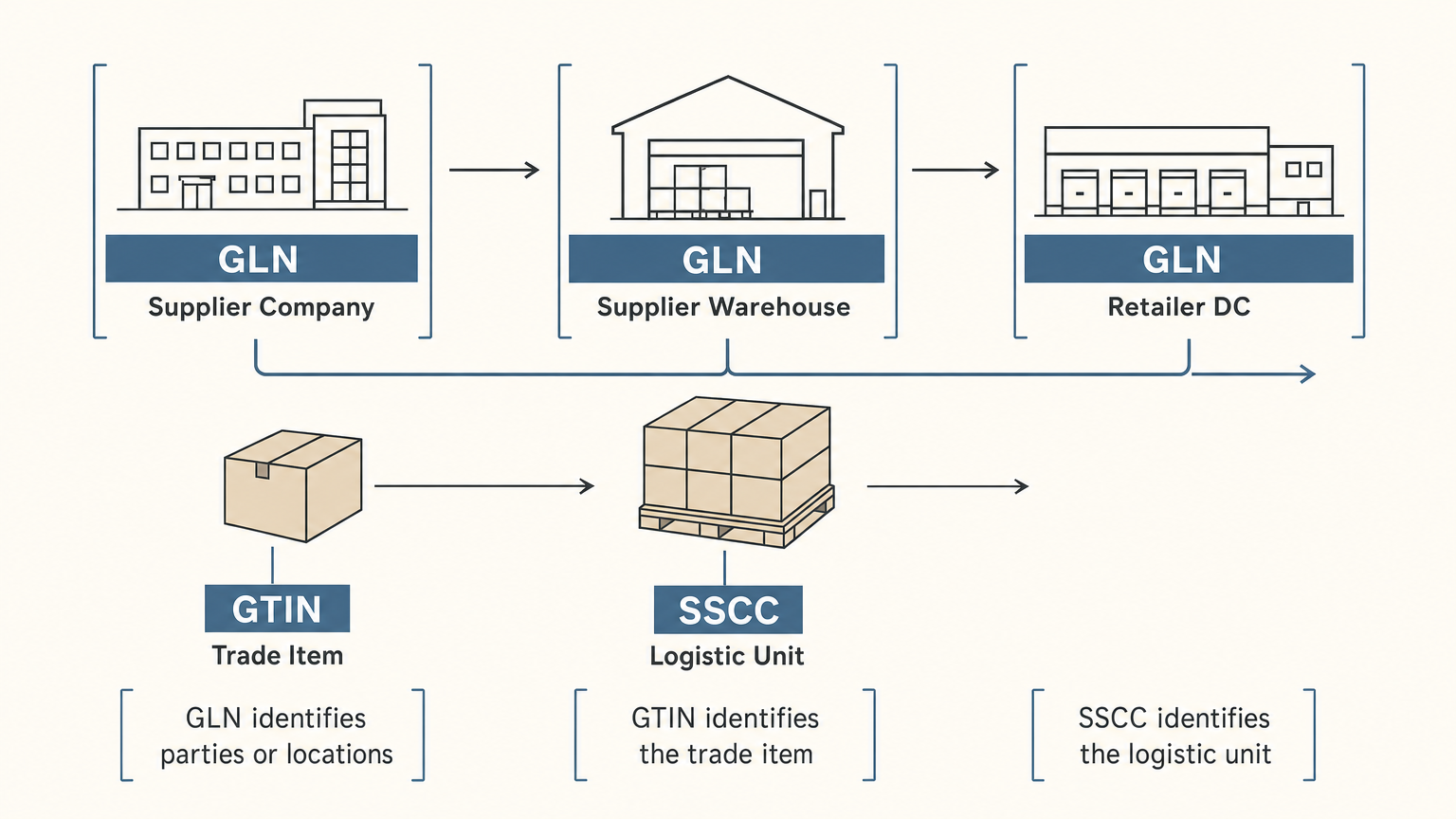
GLN stands for Global Location Number. It is a GS1 identification key for a party or location in a business process. A party can be a legal entity or a function such as purchasing or accounts payable. A location can be physical, such as a factory, distribution center, store, or dock door, or digital, such as an EDI gateway. A GLN points systems to the master data associated with that party or location. The digits do not contain its address or contact details. GS1's General Specifications define these GLN roles and how the key is used.
A GLN has 13 digits: a GS1 Company Prefix, a location reference, and a final check digit. The prefix length depends on the license, so the location-reference length varies. Treat the GLN as an opaque identifier. Do not encode a warehouse zone, channel, or department inside the digits. GS1 recommends assigning GLNs without classifying elements, and the check digit only checks how the number is composed. It does not prove that the number belongs to the right company or location. GS1's GLN guide explains the structure.
Store the value as a 13-character identifier, not a number, so software preserves every digit. Keep its type and role beside it. A value alone will not tell your team whether the GLN identifies a supplier, a bill-to function, or a ship-to location.
GLN vs. GTIN and other retail IDs
Each identifier answers a different question. A Global Trade Item Number (GTIN) identifies a trade item. A GLN identifies a party or location. Neither replaces a retailer's vendor number or your own stock keeping unit (SKU).
| Record | Identifier | Who assigns or controls it | What it identifies |
|---|---|---|---|
| Supplier, retailer, department, warehouse, or store | GLN | The organization responsible for that party or location | Who is involved, or where an operation happens |
| Product, variant, case, or pack | GTIN | Usually the brand owner under GS1 rules | Which trade item is ordered, sold, or shipped |
| Item in your own inventory or commerce system | Stock keeping unit (SKU) | Your company | Which sellable item your own systems manage |
| Vendor or seller account in a partner portal | Vendor or seller ID | The retailer or marketplace | Which partner account or relationship is in scope |
| Pallet or other logistic unit | Serial Shipping Container Code (SSCC) | The party that creates the logistic unit | Which shipment unit is moving |
| Scanned symbol on a package or label | Barcode (data carrier) | The label creator chooses the symbol and encoded data | How encoded data is presented for a scanner to read |
A GLN does not replace a GTIN in a product feed, and a barcode is not a GLN by itself. A barcode can carry a GLN, but the GS1 Application Identifier tells a scanner how to interpret it. Systems should also store the identifier type with the digits: GS1 allows a GTIN-13 and a GLN to have the same numeric value, with the message or data carrier providing the context. Joining records on digits alone can connect the wrong entity.
Supplier identity and location records belong with your designated enterprise resource planning (ERP), master data management (MDM), or procurement system. At Catalog, we structure product and offer records for downstream commerce. Keep these records linked but separate. Our vendor data management guide explains where the boundary sits.
Where GLNs show up in retail and marketplace operations
Retailer and supplier onboarding
A supplier may use one GLN for its legal entity and separate GLNs for a purchasing function, plant, or warehouse when partners need to distinguish those records. A retailer may have its own GLN for a receiving distribution center or store. When it provides one, use that value for the partner's ship-to location. Do not use your supplier GLN to represent the retailer's site.
Partner portals may also have their own account identifiers. Best Buy's partner portal says the GLN identifies a company in its Product Data Management portal, while Best Buy vendor numbers and user logins roll up to that GLN. That is one retailer's mapping, not a universal rule that replaces every vendor number.
When a partner asks for a GLN, confirm which role it needs: your legal-entity GLN, your ship-from location, a department, or the partner-owned ship-to location. Also ask whether the field is for a supplier master, data exchange, EDI transaction, or physical label. The answer determines whose GLN belongs in the record.
EDI, GDSN, and physical receiving
GLNs can identify the parties and locations in EDI purchase orders, advance ship notices, and invoices. They connect the transaction to the organization sending it and the destination or function involved. If you and a retail partner exchange item and party master data through the Global Data Synchronization Network (GDSN), the product uses its GTIN while party and location records use GLNs. Our GDSN data-exchange guide explains the model; GS1's GDSN workflow describes how suppliers publish and trading partners subscribe to data.
On a logistic label, a GLN needs a GS1 Application Identifier (AI) so scanners know its role. AI (410) identifies a deliver-to location. AI (414) identifies a physical location and is used when marking a site such as a dock door or storage location. A pallet's SSCC identifies the logistic unit; the GLN identifies a party or place. GS1's barcode guidance lists the GLN Application Identifiers.
Marketplace and omnichannel records
Marketplace operations combine several ID systems: a seller account ID, a channel listing or offer ID, your SKU, a product GTIN, and sometimes a GLN for the supplier or a location. Keep each value in its own field. A GLN is not a product identifier or a marketplace listing ID. It belongs in the supplier, party, or location record when that channel's program asks for it.
Do not assume every marketplace requires a GLN. Requirements vary by marketplace and seller program. If a portal requests a GLN, confirm whether it wants your company identity, a ship-from site, the data provider, or the destination location. Do not enter a GLN into a GTIN, SKU, or seller-account field to get past validation. Our third-party marketplace guide explains how channel listing rules differ from the underlying product record.
Choose what each GLN should identify
Start with the business question a partner or system needs to answer:
- Which legal entity is sending an order, invoice, or product record?
- Which function should receive a document or payment?
- Which warehouse or store is shipping or receiving goods?
- Which digital endpoint is used for an EDI or data exchange?
If order, delivery, and invoice processes all happen at the company level and no site or function needs to be distinguished, one GLN may be enough. If an operation needs to distinguish a particular location or function, allocate a separate GLN for it. GS1 requires a separate, unique GLN when one party or location needs to be distinguished from another, while each organization decides how much detail its operations need.
Use a GLN your organization is licensed to use when identifying itself. For a physical site, GS1 assigns responsibility to the owner or primary user; a directly involved trading partner may be a primary user. In practice, a supplier should use the retailer's existing GLN for a retailer-owned destination and keep its own GLNs for its business and sites. Do not buy, lend, or reuse another company's GLN to represent your own business.
Get and validate a GLN
First check whether the company or site already has a GLN. U.S. teams can search records in the GS1 US Data Hub with a Location View/Use subscription. Results can include the GLN's state, type, location name, address, and last-updated date. Elsewhere, check with the GS1 Member Organization that issued the number or its lookup service.
If you need a new GLN, your organization can allocate GLNs from a licensed GS1 Company Prefix or obtain individual GLNs through a GS1 Member Organization. The GS1 prefix determines how many GLNs your organization can create. GLNs are licensed to the organization using them; they are not numbers to purchase from a broker or another supplier.
Before you send a GLN to a partner:
- Check that it has 13 numeric characters and a valid check digit.
- Confirm the registered name, location, GLN type, and status match the role the partner requested. A valid check digit alone does not confirm ownership.
- Store the GLN with its owner, party or location type, address, source, status, and role such as
ship_from,ship_to, orbill_to. - Map it to the partner's exact portal or EDI field. Test the transaction before relying on the value for live orders or deliveries.
- Share the GLN and its associated master data with trading partners before the first transaction.
Keep GLN records current
A GLN is a key to master data, so outdated records can send documents or deliveries to the wrong place. Notify trading partners when a new GLN is assigned or when its associated information changes. Keep a record of the GLN's owner, role, current status, and the systems or partners that use it.
Do not assume every address change requires a new GLN. GS1's GLN Allocation Rules distinguish a physical site moving to a new location from an administrative street-name or number change where the site stays put. A legal entity can also keep its GLN when it moves if that GLN does not also identify a physical location. A combined GLN must satisfy the rules for every party or location it identifies. Local law or a partner agreement can require stricter handling.
When a party or location is retired, stop using its GLN for new transactions. Do not reassign it to a different party or location; GS1's non-reuse rule has only narrow exceptions. When in doubt, apply the allocation rule to what the GLN actually identifies, then update every affected partner record before switching identifiers.
GLNs keep partner identity and location data stable. Product descriptions, attributes, availability, and offer data are a separate layer. At Catalog, our product data layer structures product records for commerce systems and AI shopping surfaces. If product data is the next bottleneck across your retail channels, read our Catalog API guide.
